
If you have ever stepped on a scale and wondered whether your weight is
appropriate for your height, you may have come across the term BMI.
BMI, or Body Mass Index, is a simple measurement that compares your weight
with your height and can provide a general indication of weight status.
But what exactly does BMI mean? How is it calculated, and what does your
number tell you about your health?
In this guide, we explain what BMI is, how to calculate it, how to
understand BMI categories, and why BMI should be considered alongside other
health factors.
Quick answer: BMI is a measurement of weight relative to
height. For adults, it is commonly used as a screening tool to identify
weight ranges that may be associated with health risks.
What Is BMI?
BMI stands for Body Mass Index. It is a numerical value
calculated using a person’s weight and height.
BMI is commonly used as a screening measurement because it is simple,
inexpensive, and easy to calculate. For adults, BMI can help indicate
whether a person’s weight falls within an underweight, healthy weight,
overweight, or obesity category.
However, BMI is not a direct measurement of body fat and should not be used
by itself to determine someone’s overall health.
How Is BMI Calculated?
Calculating BMI is straightforward. When using metric units, the formula is:
BMI = Weight (kg) ÷ Height² (m)
For example, suppose an adult weighs 70 kg and is
1.75 meters tall.
BMI = 70 ÷ (1.75 × 1.75)
BMI ≈ 22.9
This result falls within the healthy-weight BMI range for adults.
Calculate Your BMI Online
You do not need to calculate the formula manually. You can use the
FitMivo BMI Calculator
to calculate your BMI quickly using your height and weight.
Simply enter your information, and the calculator can provide your BMI
result and corresponding category.
Check Your BMI
Find out your BMI and understand which adult BMI category your result
falls into.
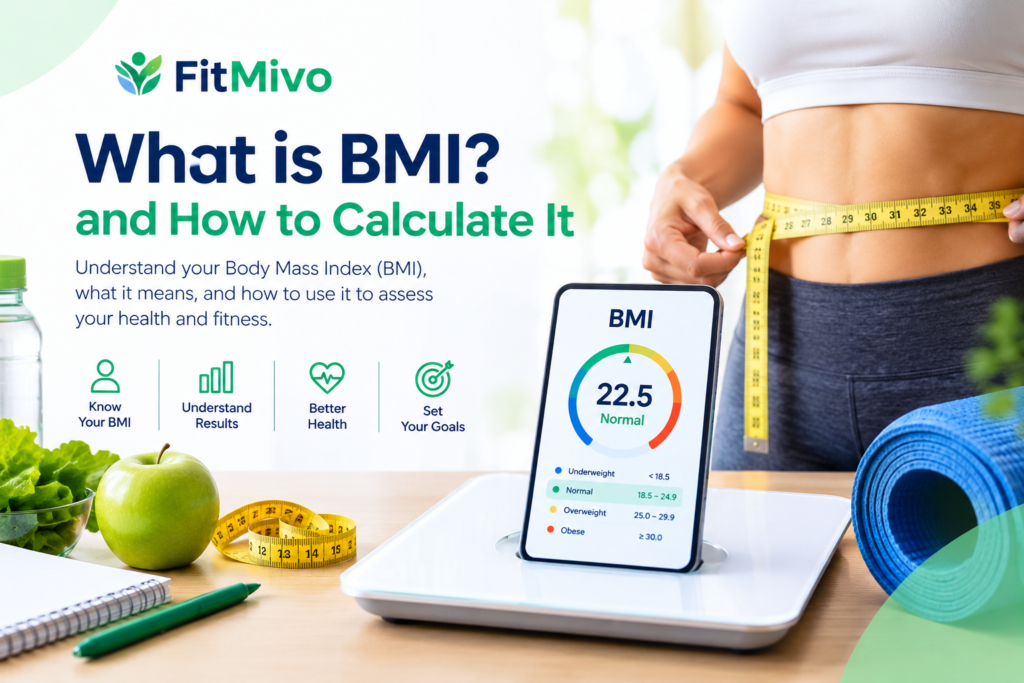
BMI Categories for Adults
For adults aged 20 and older, BMI is generally grouped into four main
categories.
| BMI Range | Category |
|---|---|
| Below 18.5 | Underweight |
| 18.5 – 24.9 | Healthy Weight |
| 25.0 – 29.9 | Overweight |
| 30.0 or higher | Obesity |
These categories are used for adults and are intended as a screening
framework rather than a diagnosis.
What Does a Healthy BMI Mean?
A BMI between 18.5 and 24.9 is generally classified as
the healthy-weight range for adults.
Being within this range does not automatically mean that a person is
completely healthy. Health is influenced by many factors, including
physical activity, nutrition, blood pressure, cholesterol, medical history,
sleep, and other aspects of lifestyle and health.
In the same way, having a BMI outside this range does not by itself
determine whether someone is healthy or unhealthy.
What Does a Low BMI Mean?
A BMI below 18.5 is classified as underweight for adults.
A low BMI may be associated with inadequate nutrition or other health
factors in some people. However, BMI alone cannot explain why a person’s
weight is low.
If you have experienced unexpected weight loss or are concerned about
being underweight, discussing your situation with a qualified healthcare
professional can help identify possible causes.
What Does a High BMI Mean?
For adults, a BMI of 25 or higher falls into the overweight or obesity
categories depending on the exact value.
Higher BMI values can be associated with an increased risk of certain
health conditions. However, BMI is only one potential health indicator and
should be considered together with other measurements and health factors.
Is BMI the Same for Men and Women?
For adults aged 20 and older, the standard BMI categories are applied
regardless of sex.
However, BMI does not tell you how much of your body weight comes from
muscle, fat, or bone. This means two people with the same BMI can have
different body compositions.
Why BMI Does Not Tell the Whole Story
One of the most important things to understand about BMI is that it is a
screening tool, not a complete measurement of health.
BMI cannot directly measure body fat or determine where fat is stored in
the body. It also cannot distinguish between muscle mass, bone mass, and
fat mass.
For example, someone who regularly performs strength training may have a
relatively high body weight because of increased muscle mass. Their BMI
could therefore fall into a higher category even though BMI alone does not
describe their body composition.
BMI and Body Composition
Body composition provides additional information about what makes up a
person’s body weight.
Depending on the situation, other measurements may provide useful
information alongside BMI, such as:
- Waist circumference
- Body fat percentage
- Blood pressure
- Blood glucose
- Cholesterol levels
- Physical activity level
- Medical history
Looking at several health indicators can provide a more complete picture
than relying on BMI alone.
Can BMI Be Used for Children?
BMI is interpreted differently for children and teenagers.
For children and adolescents from ages 2 through 19, BMI is interpreted
using age- and sex-specific BMI percentiles rather than the standard adult
BMI categories.
Therefore, the adult BMI categories in this article should not be used to
assess children or teenagers.
How Accurate Is a BMI Calculator?
A BMI calculator can accurately calculate the BMI number when the correct
height and weight are entered.
The limitation is not usually the mathematical calculation itself. The
limitation is what the number can tell you about an individual person’s
health.
BMI does not directly measure body fat, muscle mass, or fat distribution.
Therefore, the result should be viewed as one piece of information rather
than a complete health assessment.
Example: Understanding a BMI Result
Imagine an adult enters the following information into a BMI calculator:
- Weight: 70 kg
- Height: 1.75 m
The calculated BMI is approximately 22.9.
Since 22.9 falls between 18.5 and 24.9, the result is within the
healthy-weight BMI category for adults.
This does not mean that the BMI number alone determines the person’s
overall health. Other health and lifestyle factors should also be
considered.
BMI vs. Body Fat Percentage
BMI and body fat percentage are not the same measurement.
BMI uses only height and weight. Body fat percentage attempts to estimate
how much of a person’s body weight is fat.
Because BMI does not distinguish muscle from fat, body composition
measurements can sometimes provide additional useful information,
particularly for people with higher levels of muscle mass.
How to Use Your BMI Result
Your BMI can be used as a starting point for understanding your weight
relative to your height.
Instead of focusing only on one number, consider your BMI together with
your overall lifestyle and other health measurements.
If your BMI concerns you, especially if you have significant weight
changes or other health issues, consider speaking with a qualified
healthcare professional.
Frequently Asked Questions About BMI
What is BMI?
BMI stands for Body Mass Index. It is a calculated measurement of weight
relative to height and is commonly used as a screening tool for adults.
How do I calculate BMI?
Using metric units, divide your weight in kilograms by your height in
meters squared:
BMI = weight (kg) ÷ height² (m).
What is a normal BMI?
For adults aged 20 and older, a BMI from 18.5 to 24.9 is
generally classified as the healthy-weight range.
Is a BMI of 25 considered overweight?
Yes. For adults, a BMI of 25.0 to 29.9 falls within the overweight
category.
Is BMI a measure of body fat?
No. BMI does not directly measure body fat. It uses height and weight and
cannot distinguish between fat, muscle, and bone mass.
Does BMI work for athletes?
BMI may be less informative for people with high amounts of muscle mass
because muscle contributes to body weight. A person with substantial
muscle mass may have a higher BMI without BMI accurately describing their
body composition.
Can children use an adult BMI calculator?
No. Children and teenagers require BMI-for-age interpretation using
age- and sex-specific percentiles rather than standard adult categories.
Calculate Your BMI With FitMivo
Understanding your BMI is a useful first step toward learning more about
your weight relative to your height.
Use the free
FitMivo BMI Calculator
to calculate your BMI and see which adult category your result falls into.
Ready to Check Your BMI?
Enter your height and weight to calculate your BMI in seconds.
Final Takeaway
BMI is a simple way to compare weight with height and is widely used as a
screening measure for adults. A BMI below 18.5 is classified as
underweight, 18.5–24.9 as healthy weight, 25.0–29.9 as overweight, and
30.0 or higher as obesity.
However, BMI should not be treated as a complete assessment of health.
Because it cannot distinguish between muscle, fat, and bone or show where
fat is stored, it is best considered alongside other health information.
Use BMI as one useful data point, not as the only measure of your health
or fitness.
Health Disclaimer: This article is provided for general
educational and informational purposes only. BMI is a screening measure
and is not a diagnosis or a substitute for professional medical advice.
If you have concerns about your weight, health, or nutrition, consult a
qualified healthcare professional.