
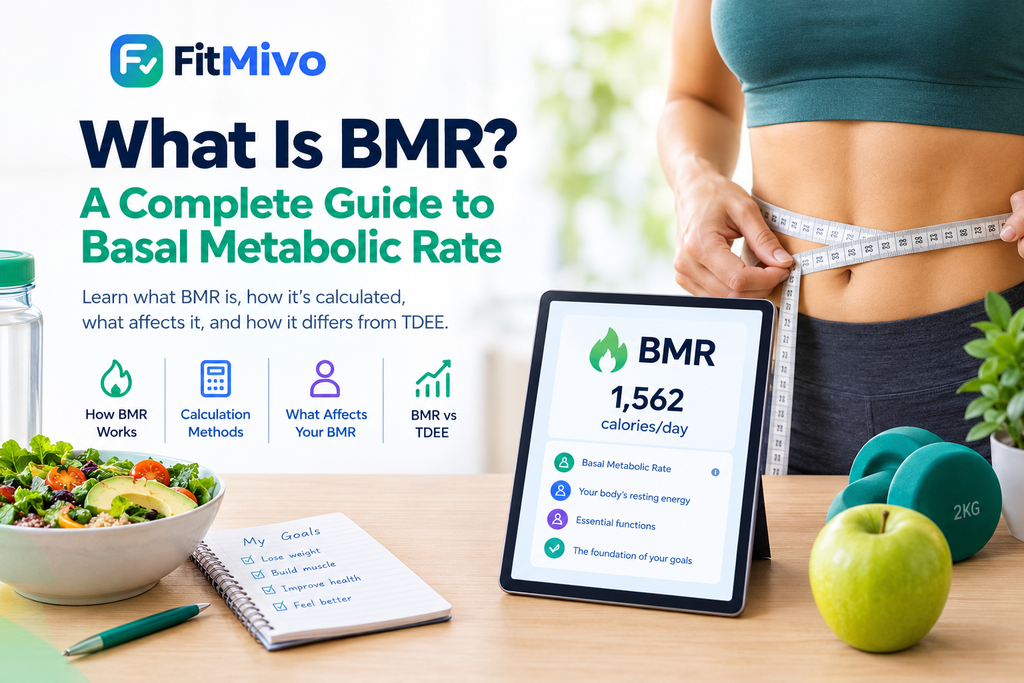
doing absolutely nothing? The answer starts with your
Basal Metabolic Rate (BMR).
BMR is an important concept in nutrition, fitness, and weight management.
It estimates the amount of energy your body needs to support essential
functions such as breathing, circulation, and maintaining normal body
processes while at rest.
In this guide, we explain what BMR is, how it is calculated, what
affects your BMR, and how BMR differs from TDEE.
Quick answer: BMR stands for Basal Metabolic Rate. It is
an estimate of the minimum amount of energy your body requires to
maintain essential functions while at rest.
What Is BMR?
BMR stands for Basal Metabolic Rate. It refers to the
amount of energy the body uses to maintain essential physiological
functions when the body is in a basal resting state.
Your body continues to use energy even while you are sleeping or resting.
Your heart continues to beat, your lungs continue to work, your brain
remains active, and your body maintains its internal environment.
All of these processes require energy.
BMR is therefore an important starting point when estimating how much
energy a person may need each day.
What Does BMR Include?
BMR represents energy required for basic functions that keep the body
alive and functioning.
These include processes such as:
- Breathing
- Maintaining heart function and circulation
- Maintaining body temperature
- Supporting brain function
- Maintaining cells and tissues
- Supporting other essential physiological processes
BMR does not represent all the calories you burn during a
normal day. Walking, exercising, working, digesting food, and other
activities require additional energy.
Why Is BMR Important?
Understanding your BMR can help you better understand your daily energy
requirements.
BMR is often used as a starting point when estimating total daily energy
expenditure. Once activity and other energy costs are considered, you can
arrive at a broader estimate of your daily calorie needs.
This is particularly useful when learning about:
- Daily calorie needs
- Weight management
- Energy balance
- Fitness planning
- Nutrition planning
How Is BMR Calculated?
Your exact BMR cannot normally be determined from height and weight alone.
Measuring resting energy expenditure under controlled conditions can
provide a more direct measurement.
For everyday use, however, mathematical equations can provide an
estimate of BMR using information such as age, sex, height,
and weight.
One commonly used approach is the Mifflin-St Jeor equation.
Mifflin-St Jeor Equation for Men
BMR = (10 × weight in kg) + (6.25 × height in cm) − (5 × age) + 5
Mifflin-St Jeor Equation for Women
BMR = (10 × weight in kg) + (6.25 × height in cm) − (5 × age) − 161
These equations provide estimates rather than exact measurements. An
individual’s actual energy expenditure can vary because metabolism is
influenced by body composition, physiological factors, activity, and other
variables.
Example of a BMR Calculation
Consider a hypothetical adult with the following information:
- Weight: 70 kg
- Height: 175 cm
- Age: 30 years
Using the Mifflin-St Jeor equation for a man:
BMR = (10 × 70) + (6.25 × 175) − (5 × 30) + 5
BMR = 700 + 1093.75 − 150 + 5
BMR ≈ 1,649 calories per day
This means the estimated BMR is approximately 1,649 calories per day.
However, this number is not the person’s total daily
calorie requirement because normal daily activity requires additional
energy.
Calculate Your BMR Online
You can calculate your estimated BMR using the free
FitMivo BMR Calculator
.
Enter your age, sex, height, and weight to receive an estimated BMR without
having to calculate the equation manually.
What Factors Affect BMR?
BMR is different from one person to another. Several factors can influence
resting energy expenditure.
1. Body Size
Body size is one of the factors associated with energy requirements.
Larger bodies generally require more energy to maintain their tissues and
basic functions.
2. Body Composition
Body composition also matters. Lean tissue is metabolically active, and
differences in body composition can contribute to differences in resting
energy expenditure.
3. Age
Energy expenditure can change over the course of life. Changes in body
composition and other physiological factors can contribute to differences
in resting energy requirements as people age.
4. Sex
Average energy requirements can differ between males and females because
body size and composition tend to differ between populations. This is one
reason commonly used BMR equations include sex as an input.
5. Physiological and Health Factors
Hormonal and physiological conditions, illness, medications, temperature,
and other factors can affect energy expenditure.
This is one reason a BMR calculator should be viewed as an estimation tool
rather than a precise measurement of an individual’s metabolism.
BMR vs. TDEE: What Is the Difference?
BMR and TDEE are related, but they are not the same thing.
| BMR | TDEE |
|---|---|
| Energy needed for basic functions at rest | Estimated total energy expenditure over a typical day |
| Does not account for normal daily activity | Includes activity and other components of energy expenditure |
| Used as a starting point for energy estimates | More useful for estimating daily calorie needs |
Total daily energy expenditure includes energy used at rest, energy used
for physical activity, and the thermic effect of food.
What Is TDEE?
TDEE stands for Total Daily Energy Expenditure.
It represents an estimate of the total amount of energy your body uses
during a typical day.
TDEE takes into account more than your resting metabolism. It includes
energy associated with physical activity and the thermic effect of food,
in addition to resting energy expenditure.
If you want to understand your daily calorie needs, your TDEE estimate can
therefore be more useful than looking at BMR alone.
BMR → Activity → TDEE
BMR provides a starting point. Your activity and other energy expenditure
contribute to your total daily energy needs.
Can You Use BMR to Lose Weight?
BMR can help you understand the energy your body requires at rest, but it
should not be treated as your recommended daily calorie intake.
Weight management involves the relationship between energy intake and
energy expenditure over time. Since BMR is only one component of total
energy expenditure, using BMR alone to determine how many calories you
should eat would be incomplete.
A broader estimate such as TDEE can provide additional context when
considering daily calorie needs.
If you are trying to change your weight, consider your overall nutrition,
physical activity, health status, and individual circumstances rather than
relying on a single calculated number.
Does Exercise Increase BMR?
Exercise increases energy expenditure because physical activity requires
additional energy.
However, it is important to distinguish between your BMR and the calories
you burn through physical activity.
Regular strength training can also contribute to changes in body
composition, which may influence resting energy expenditure over time.
The relationship between exercise, body composition, and metabolism is
more complex than simply adding a fixed number of calories to BMR.
Is a Higher BMR Always Better?
Not necessarily.
BMR is simply an estimate of energy expenditure under specific resting
conditions. A higher or lower BMR does not by itself indicate whether a
person is healthier or fitter.
The goal should not be to maximize BMR simply because the number is higher.
Instead, focus on appropriate nutrition, regular physical activity,
adequate recovery, and sustainable health habits.
Why BMR Calculators Are Estimates
Online BMR calculators use equations based on population data. They are
useful for estimating energy requirements, but they cannot perfectly
measure an individual’s metabolism.
Your actual energy expenditure can be affected by factors that a simple
calculator cannot fully capture.
For this reason, treat your BMR result as a useful starting estimate rather
than an exact measurement.
BMR and Daily Calorie Needs
If you are trying to answer the question
“How many calories do I need each day?”, BMR is only part
of the calculation.
Your daily energy needs depend on your resting energy expenditure,
physical activity, and the energy required to process food.
This is why two people with similar BMR values can still have different
daily calorie requirements if their activity levels and other factors
differ.
Frequently Asked Questions About BMR
What does BMR stand for?
BMR stands for Basal Metabolic Rate. It estimates the
energy required to maintain essential body functions while in a basal
resting state.
What is a good BMR?
There is no single “good” BMR number. BMR varies according to factors such
as body size, body composition, age, and sex. A BMR calculator provides an
estimate rather than a health score.
How many calories does BMR burn?
BMR is usually expressed as calories per day and represents estimated
energy expenditure under basal resting conditions. It is not the same as
the number of calories you should eat each day.
Is BMR the same as TDEE?
No. BMR estimates energy used for basic functions at rest, while TDEE
estimates total daily energy expenditure, including physical activity and
the thermic effect of food.
Can I increase my BMR?
BMR is influenced by body composition and several physiological factors.
Changes in body composition may affect resting energy expenditure, but
there is no single method that reliably increases everyone’s BMR by a
specific amount.
Should I eat below my BMR to lose weight?
BMR should not be treated as a personal calorie-intake target. It represents
estimated energy expenditure at rest, while your actual daily energy needs
include activity and other energy costs.
Is a BMR calculator accurate?
A calculator can accurately perform the equation using the information you
provide, but the resulting BMR is still an estimate. Actual resting energy
expenditure varies between individuals.
Calculate Your BMR With FitMivo
Understanding your BMR is a useful first step when learning how your body
uses energy.
Use the free
FitMivo BMR Calculator
to estimate your basal metabolic rate based on your personal information.
What to Read Next
Once you understand BMR, the next step is learning about your total daily
calorie requirements.
Read our guide:
What Is TDEE? How to Calculate Your Total Daily Energy Expenditure
You can also learn more about daily calorie requirements in our guide:
How Many Calories Do I Need a Day?
Final Takeaway
BMR, or Basal Metabolic Rate, is an estimate of the energy
your body requires to maintain essential functions while at rest.
It is an important component of total daily energy expenditure, but it is
not the same as your total daily calorie requirement.
Your daily energy needs are also influenced by physical activity, the
thermic effect of food, body composition, age, and other individual
factors.
Use BMR as a starting point for understanding energy expenditure, and
consider TDEE and your overall lifestyle when thinking about daily calorie
needs.
Health Disclaimer: This article is provided for general
educational and informational purposes only. BMR and calorie calculations
are estimates and are not medical advice or a diagnosis. Individual
nutritional needs can vary. If you have a medical condition, are pregnant,
are under medical treatment, or have specific nutrition or weight concerns,
consult a qualified healthcare professional.