
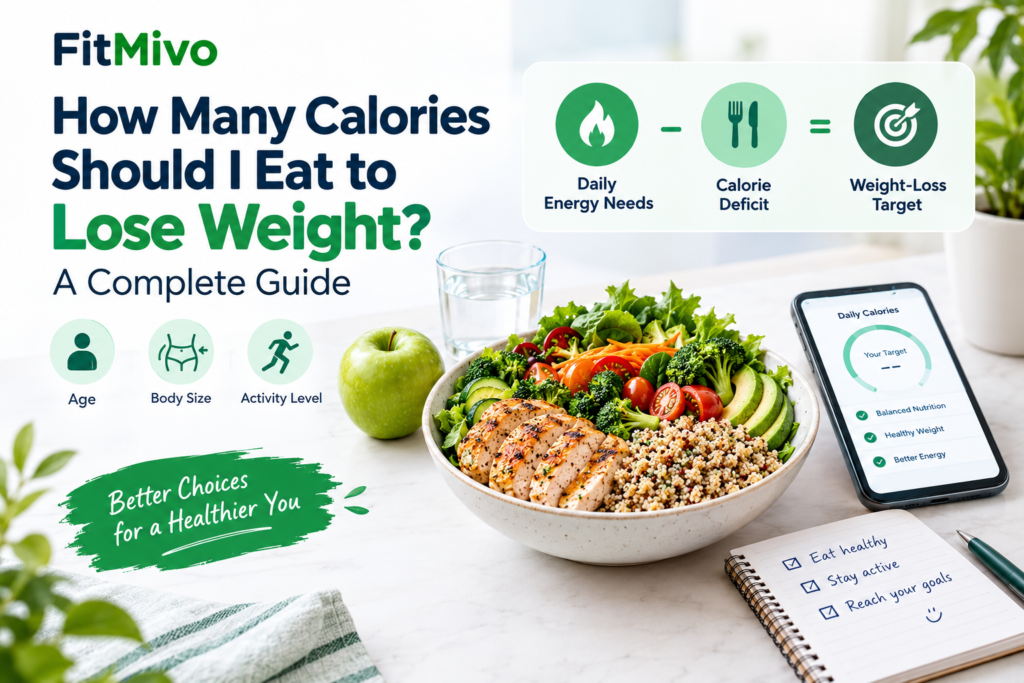
If you are trying to lose weight, one of the first questions you may have is how many calories you should eat each day. Calorie needs are different from person to person, so there is no single number that works for everyone.
In this guide, FitMivo explains how calorie needs are estimated, how maintenance calories relate to weight loss, how a calorie deficit works, and how to choose a practical calorie target.
How Many Calories Should I Eat to Lose Weight?
There is no universal calorie intake for weight loss. Your daily calorie needs depend on several factors, including age, sex, body size, and physical activity.
The National Academies defines Estimated Energy Requirement (EER) using factors such as age, sex, weight, height, and physical activity level.
For this reason, a calorie target that works for one person may be too high or too low for another person.
What Determines Your Daily Calorie Needs?
Your body uses energy throughout the day for many different functions. Some of this energy is used to keep your body functioning at rest, while additional energy is used for digestion, movement, exercise, and other activities.
Several factors can influence how many calories you need.
1. Age
Calorie needs can change with age. Younger adults often require more energy than older adults, although individual differences can be substantial.
2. Sex
Average calorie requirements differ between men and women because body size, body composition, and energy expenditure can differ.
3. Height and Weight
Larger bodies generally require more energy to support daily functions and movement. Height and body weight are therefore commonly used when estimating calorie requirements.
4. Physical Activity
Your activity level can have a significant effect on your total daily energy expenditure. Someone who is highly active generally requires more calories than someone with a sedentary lifestyle.
5. Body Composition
Body composition can also influence energy expenditure. Muscle tissue and other tissues contribute to your body's energy needs.
Calories for Weight Loss vs. Maintenance Calories
Before choosing a calorie target for weight loss, it helps to understand your estimated maintenance calories.
Maintenance calories are approximately the amount of energy you need to maintain your current body weight under your usual conditions.
| Goal | Relationship to Maintenance | General Direction |
|---|---|---|
| Weight loss | Below maintenance | Calorie deficit |
| Weight maintenance | Around maintenance | Energy balance |
| Weight gain | Above maintenance | Calorie surplus |
NIDDK explains that reducing calorie intake from food and beverages can support weight loss, especially when combined with healthy eating and physical activity.
How to Estimate Your Maintenance Calories
One common approach is to estimate your Total Daily Energy Expenditure (TDEE).
TDEE represents the approximate amount of energy your body uses throughout the day.
You can learn more about this concept in our complete guide: What Is TDEE? A Complete Guide to Total Daily Energy Expenditure.
You can also use the FitMivo:
How Does a Calorie Deficit Help With Weight Loss?
A calorie deficit occurs when your average calorie intake is lower than the amount of energy your body uses.
For example, if someone's estimated maintenance requirement were 2,400 calories per day and they consumed fewer calories on average, the resulting energy deficit could contribute to weight loss over time.
Calorie Deficit = Maintenance Calories − Calories Consumed
The exact response to a calorie deficit varies between individuals, and weight loss does not necessarily occur at a constant rate.
For a deeper explanation, read: What Is a Calorie Deficit? A Complete Guide to Losing Weight Safely.
Is There a Minimum Number of Calories Everyone Should Eat?
There is no single minimum calorie target that is appropriate for every adult.
Individual energy and nutritional requirements vary. A calorie target should provide enough food to support nutritional needs while fitting the individual's goals and circumstances.
Very restrictive diets can be difficult to sustain and may make it harder to obtain adequate nutrition.
If you are considering a significant calorie restriction, especially if you have a medical condition or other health concerns, speak with a qualified healthcare professional.
How Many Calories Should I Eat Based on My Activity Level?
Activity level is an important part of estimating energy needs.
| Activity Level | Typical Description | Effect on Calorie Needs |
|---|---|---|
| Sedentary | Little structured exercise and mostly sitting | Lower energy expenditure |
| Lightly Active | Some walking or light exercise | Moderately higher energy expenditure |
| Moderately Active | Regular exercise and an active lifestyle | Higher energy expenditure |
| Very Active | Frequent exercise or physically demanding activity | Much higher energy expenditure |
These categories are general descriptions. Your actual energy expenditure can differ from another person with the same activity label.
Should You Count Every Calorie?
Not necessarily.
Calorie tracking can help some people understand their eating habits and portion sizes, but it is not the only way to manage calorie intake.
Other approaches include:
- Building meals around vegetables and other nutrient-dense foods.
- Choosing appropriate portion sizes.
- Including protein-rich foods in meals.
- Reducing frequent high-calorie drinks.
- Planning meals in advance.
- Eating slowly and paying attention to hunger and fullness.
- Increasing regular physical activity.
NIDDK recommends a healthy eating pattern that includes vegetables, fruits, whole grains, protein foods, and other nutritious choices.
What Should I Eat While Trying to Lose Weight?
A weight-loss diet does not have to eliminate specific food groups.
Instead, focus on an overall eating pattern that provides important nutrients while helping you manage your calorie intake.
Good Foods to Include
- Vegetables
- Whole fruits
- Whole grains
- Beans, peas, and lentils
- Lean protein sources
- Fish and seafood
- Eggs
- Nuts and seeds
- Low-fat or fat-free dairy products or suitable alternatives
- Healthy sources of dietary fat
The goal is not simply to eat fewer calories. Food quality, nutritional adequacy, hunger, preferences, and sustainability also matter.
Can Exercise Help You Lose Weight?
Yes. Physical activity increases energy expenditure and provides many health benefits beyond weight management.
NIDDK notes that healthy adults should generally aim for at least 150 minutes of moderate-intensity aerobic activity per week, along with muscle-strengthening activities on two or more days each week.
For people trying to lose weight and keep it off, some individuals may benefit from more activity. NIDDK notes that around 300 minutes per week may be useful for weight-loss and weight-maintenance goals.
If you are currently inactive, start gradually and choose activities that you can perform safely and consistently.
Why Your Calorie Target May Change
Your calorie needs are not necessarily the same throughout your life or even throughout a weight-loss journey.
As body weight decreases, your body may require fewer calories. NIDDK notes that metabolism slows during weight loss and that the body may need fewer calories at a lower weight.
Other factors can also affect your weight and energy needs, including physical activity, sleep, medications, health conditions, genetics, and lifestyle habits.
How Fast Should You Lose Weight?
Weight loss does not need to happen as quickly as possible to be meaningful.
A sustainable approach is generally more useful than extreme restriction. NIDDK notes that structured weight-loss approaches typically combine a reduced-calorie eating plan with physical activity and ongoing support.
Your progress can also fluctuate from week to week because body weight is affected by factors other than body fat, including water and food contents.
What If You Are Not Losing Weight?
If your weight is not changing as expected, there can be several possible reasons.
- Your actual calorie intake may be higher than estimated.
- Your activity level may have changed.
- Your energy needs may have decreased as your weight changed.
- Short-term water fluctuations may hide changes in body fat.
- Your initial calorie estimate may not accurately represent your current needs.
Instead of immediately making a drastic change, look at your longer-term trend and consider whether your current habits are consistent with your goal.
How FitMivo Can Help
FitMivo provides free calculators that can help you understand your estimated calorie needs and the concepts behind weight management.
You can also learn more about the concepts behind these calculations:
- What Is BMR? A Complete Guide to Basal Metabolic Rate
- What Is TDEE? A Complete Guide to Total Daily Energy Expenditure
- What Is a Calorie Deficit? A Complete Guide to Losing Weight Safely
- How Many Calories Do I Need a Day? A Complete Guide
- What Is BMI? A Complete Guide to Body Mass Index
Calculate Your Daily Calorie Needs
Get an estimate of your daily calorie needs with FitMivo's free calculator.
Try the Calorie CalculatorFrequently Asked Questions
How many calories should I eat to lose weight?
There is no single calorie number that works for everyone. Your target depends on your age, sex, height, weight, activity level, and other individual factors. A useful starting point is to estimate your maintenance calories and then choose a sustainable calorie deficit.
How do I calculate calories for weight loss?
First estimate your daily energy needs or maintenance calories. Then choose an appropriate calorie deficit rather than using an arbitrary calorie number.
Is 1,200 calories a day enough to lose weight?
A specific calorie level should not be assumed to be appropriate for everyone. Individual energy and nutritional needs vary, and very restrictive intake may not provide adequate nutrition. If you are considering a very low calorie diet, seek professional guidance.
Should I eat fewer calories if I exercise?
Exercise increases energy expenditure, but estimating exactly how many calories an individual burns during exercise can be difficult. It is usually better to consider your overall activity level when estimating daily energy needs rather than relying on exercise calorie estimates alone.
Why am I not losing weight even though I am eating fewer calories?
Weight can fluctuate for many reasons, and short-term changes may not reflect changes in body fat. Your actual calorie intake, activity level, energy needs, and water balance can all influence your results.
Can I lose weight without exercise?
Changes in calorie intake can contribute to weight loss, but physical activity provides important health benefits and can support weight management. Regular activity is therefore an important part of a healthy lifestyle.
Key Takeaways
- There is no universal calorie target for weight loss.
- Your calorie needs depend on factors such as age, sex, height, weight, and physical activity.
- Estimating maintenance calories can help you choose a realistic calorie target.
- A calorie deficit occurs when calorie intake is lower than energy expenditure over time.
- Eating fewer calories does not mean you should ignore food quality and nutrition.
- Regular physical activity provides important health benefits and can support weight management.
- Your calorie needs may change as your body weight and activity level change.
- A sustainable approach is generally preferable to extreme calorie restriction.
This article is provided for educational and informational purposes only. FitMivo calculators provide estimates and are not medical advice, diagnosis, or treatment. Individual calorie and nutritional needs can vary. If you are under 18, pregnant or breastfeeding, have a medical condition, have a history of an eating disorder, or are considering significant dietary changes, consult a qualified healthcare professional.