
If you have ever used a calorie calculator, you may have seen the terms BMR and TDEE. Although they are closely related, they do not mean the same thing.
Understanding the difference between BMR and TDEE can help you better understand your daily calorie needs, maintenance calories, and how calorie calculations are used for weight management.
In this guide, FitMivo explains what BMR and TDEE mean, how they are calculated, how they are related, and when you may want to use each one.
What Is BMR?
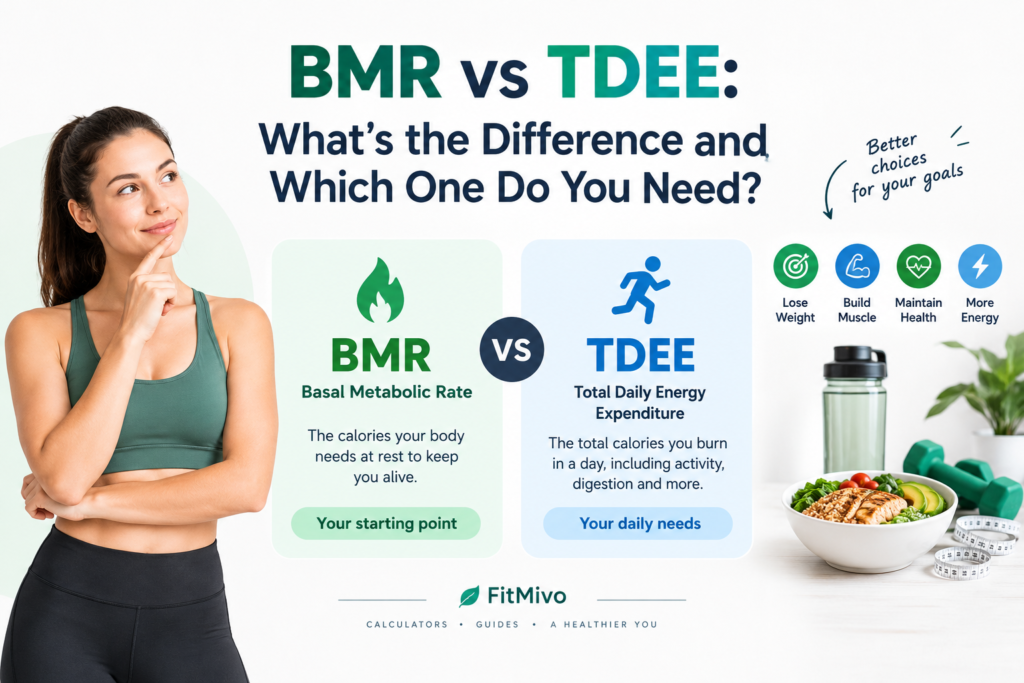
BMR stands for Basal Metabolic Rate. It refers to the amount of energy your body requires to support essential functions while at rest.
These functions include processes such as breathing, circulation, maintaining body temperature, and supporting normal organ function.
BMR is therefore a measure of your body's basic energy requirements. It does not represent all the calories you burn during a normal day.
For a more detailed explanation, read: What Is BMR? A Complete Guide to Basal Metabolic Rate.
What Is TDEE?
TDEE stands for Total Daily Energy Expenditure.
TDEE represents the total amount of energy your body uses throughout a typical day. It includes energy used at rest as well as energy associated with eating and physical activity.
According to the National Academies, total energy expenditure includes resting metabolic rate, the thermic effect of food, and physical activity.
For a complete explanation, read: What Is TDEE? A Complete Guide to Total Daily Energy Expenditure.
BMR vs TDEE: The Main Difference
BMR
Basal Metabolic Rate
- Energy needed at rest
- Focuses on basic body functions
- Does not represent your entire daily calorie expenditure
- Used as a starting point for estimating calorie needs
TDEE
Total Daily Energy Expenditure
- Total daily energy expenditure
- Includes resting energy expenditure
- Includes physical activity and other energy expenditure
- Useful for estimating maintenance calorie needs
BMR vs TDEE Comparison Table
| Feature | BMR | TDEE |
|---|---|---|
| Full Name | Basal Metabolic Rate | Total Daily Energy Expenditure |
| Measures | Energy needed at rest | Total daily energy expenditure |
| Physical Activity Included? | No | Yes |
| Food Thermic Effect Included? | No | Yes |
| Represents Daily Calorie Needs? | No | Approximately |
| Useful for | Understanding resting energy needs | Estimating maintenance calories |
How Are BMR and TDEE Related?
BMR and TDEE are closely connected because your resting energy expenditure is one of the major components of your total daily energy expenditure.
In simple terms, BMR represents the energy required by your body at rest, while TDEE accounts for the additional energy your body uses during the day.
TDEE > BMR
because TDEE includes energy expenditure beyond resting needs.
The exact relationship varies between individuals because activity levels, body composition, food intake, and other factors differ.
What Does TDEE Include?
TDEE is made up of several components of energy expenditure.
1. Resting Energy Expenditure
This is the energy your body uses to maintain essential physiological functions when you are resting.
2. Physical Activity
This includes structured exercise as well as everyday movement such as walking, climbing stairs, household activities, and other physical tasks.
3. Thermic Effect of Food
Your body also uses energy to digest, absorb, and process the food you consume.
The National Academies identifies resting metabolic rate, thermic effect of food, and physical activity as the three core components of total energy expenditure.
How Is BMR Calculated?
BMR can be estimated using mathematical equations that use information such as age, sex, height, and body weight.
One commonly used equation is the Mifflin-St Jeor equation.
For Men
For Women
These equations provide estimates rather than direct measurements of an individual's actual metabolic rate.
You can use the FitMivo:
How Is TDEE Calculated?
TDEE can be estimated by starting with an estimate of resting energy expenditure and accounting for activity and other components of daily energy expenditure.
A common simplified method uses an activity multiplier.
Common activity factors used in calculator formulas may include values such as:
| Activity Level | Example Description | Common Factor |
|---|---|---|
| Sedentary | Little exercise or mostly sitting | 1.20 |
| Lightly Active | Light exercise or activity several days per week | 1.375 |
| Moderately Active | Moderate exercise or regular activity | 1.55 |
| Very Active | Frequent exercise or highly active lifestyle | 1.725 |
| Extremely Active | Very high activity or physically demanding lifestyle | 1.90 |
These factors are simplified estimates. Your actual energy expenditure may differ from the estimate produced by a calculator.
Example: BMR vs TDEE
Imagine a person has an estimated BMR of 1,600 calories per day.
If an activity factor of 1.55 were used, the estimated TDEE would be:
In this simplified example, 1,600 calories represents estimated resting energy needs, while approximately 2,480 calories represents estimated total daily energy expenditure.
Which One Should You Use: BMR or TDEE?
It depends on what you are trying to understand.
| Your Goal | More Useful Estimate |
|---|---|
| Understand your resting energy needs | BMR |
| Estimate your daily energy expenditure | TDEE |
| Estimate maintenance calories | TDEE |
| Understand how activity affects calorie needs | TDEE |
| Understand the starting point for metabolism calculations | BMR |
Is TDEE the Same as Maintenance Calories?
TDEE and maintenance calories are closely related, but they are not necessarily identical concepts in every context.
TDEE is an estimate of the energy your body expends during a day. Maintenance calorie intake refers to an intake level that would be expected to maintain body weight over time under similar conditions.
For a person whose weight is relatively stable, estimated energy intake and expenditure are expected to be approximately balanced. The National Academies describes energy balance in terms of dietary energy intake and energy expenditure.
Can BMR Help With Weight Loss?
BMR can help you understand the energy your body requires at rest, but BMR alone should not be used as your daily calorie target.
Your body uses additional energy through movement, exercise, digestion, and other activities.
For weight-loss planning, an estimate of your total daily energy needs is generally more useful than looking at BMR alone.
You can learn more in: How Many Calories Should I Eat to Lose Weight?
Can TDEE Help With Weight Loss?
TDEE can be useful as a starting point for understanding your estimated maintenance calorie needs.
If your goal is weight loss, you can use your estimated maintenance needs as a reference when considering your overall calorie intake.
However, calorie needs vary from person to person, and calculator results are estimates rather than exact measurements.
For more information: What Is a Calorie Deficit? A Complete Guide to Losing Weight Safely
What Factors Can Affect BMR and TDEE?
Several factors can affect energy expenditure and calorie requirements.
- Age
- Sex
- Height
- Body weight
- Body composition
- Physical activity
- Exercise habits
- Food intake
- Health conditions
- Some medications
- Changes in body weight over time
NIDDK notes that calorie needs can depend on factors such as weight, sex, age, metabolism, and physical activity.
Why Calculator Results Are Only Estimates
BMR and TDEE calculators use mathematical equations to estimate energy requirements.
They do not directly measure the exact number of calories your body uses every day.
Your actual energy expenditure can vary because of differences in body composition, activity, daily movement, metabolism, and other factors.
BMR vs TDEE: Quick Summary
| Question | Answer |
|---|---|
| What does BMR mean? | Basal Metabolic Rate |
| What does TDEE mean? | Total Daily Energy Expenditure |
| Does BMR include exercise? | No |
| Does TDEE include physical activity? | Yes |
| Which is usually closer to daily calorie needs? | TDEE |
| Can both be estimated with calculators? | Yes |
Related FitMivo Calculators
You can use FitMivo's free calculators to explore these concepts:
Calculate Your BMR and TDEE
Use FitMivo's free calculators to estimate your resting metabolic rate and total daily energy expenditure.
Calculate BMR Calculate TDEEFrequently Asked Questions
What is the main difference between BMR and TDEE?
BMR estimates the energy your body needs to support basic functions at rest. TDEE estimates the total energy your body uses throughout the day, including activity and the thermic effect of food.
Is BMR lower than TDEE?
Generally, yes. TDEE includes energy expenditure beyond resting metabolic needs, so it is normally higher than BMR.
Which is more important for weight loss, BMR or TDEE?
TDEE is generally more useful for understanding your approximate daily energy needs because it accounts for more than resting metabolism. BMR is still useful as a component of energy calculations.
Can I use my BMR as my daily calorie intake?
BMR is not intended to represent your complete daily calorie requirement. Your body also uses energy for physical activity, digestion, and other daily functions.
Does exercise increase TDEE?
Yes. Physical activity is one of the components of total daily energy expenditure, so changes in activity can affect your TDEE.
Can BMR change over time?
Yes. Energy requirements can change with factors such as age, body size, body composition, and other physiological factors.
Can TDEE change after losing weight?
Yes. When body weight decreases, energy requirements may also change. NIDDK notes that metabolism slows during weight loss and the body may require fewer calories at a lower weight.
Key Takeaways
- BMR estimates the energy your body needs at rest.
- TDEE estimates your total daily energy expenditure.
- TDEE includes resting energy expenditure, physical activity, and the thermic effect of food.
- BMR is an important component of understanding daily energy needs.
- TDEE is generally more useful when estimating maintenance calorie needs.
- Both BMR and TDEE calculator results are estimates.
- Your energy needs can change as your body weight, activity level, and other factors change.
This article is provided for educational and informational purposes only. FitMivo calculators provide estimates and are not medical advice, diagnosis, or treatment. Individual energy and nutritional needs can vary. If you have a medical condition, are pregnant or breastfeeding, are under 18, or are making significant changes to your diet or physical activity, consult a qualified healthcare professional.