
What is a healthy weight for your height? It is a common question, especially if you are trying to understand your weight, improve your health, or set a realistic fitness goal. Although height can help estimate a healthy weight range, there is no single ideal weight that applies to everyone.
Your age, body composition, muscle mass, health history, and other factors also matter. One useful starting point for adults is body mass index (BMI), a screening tool that compares weight with height.
In this FitMivo guide, you will learn how healthy weight ranges are estimated, how to interpret a weight-by-height chart, and why these numbers should be considered alongside other indicators of health.
Table of Contents
What Is a Healthy Weight by Height?
A healthy weight by height is an estimated range of body weights that may be associated with better health for adults of a particular height. One common way to estimate this range is by using BMI.
BMI is calculated using your weight and height. For adults, the standard BMI categories are:
| BMI category | BMI range |
|---|---|
| Underweight | Below 18.5 |
| Healthy weight | 18.5 to less than 25 |
| Overweight | 25 to less than 30 |
| Obesity | 30 or higher |
These categories are intended for adults aged 20 and older. Children and teenagers require age- and sex-specific growth charts, so adult BMI categories should not be used to assess their weight.
Healthy Weight Chart by Height
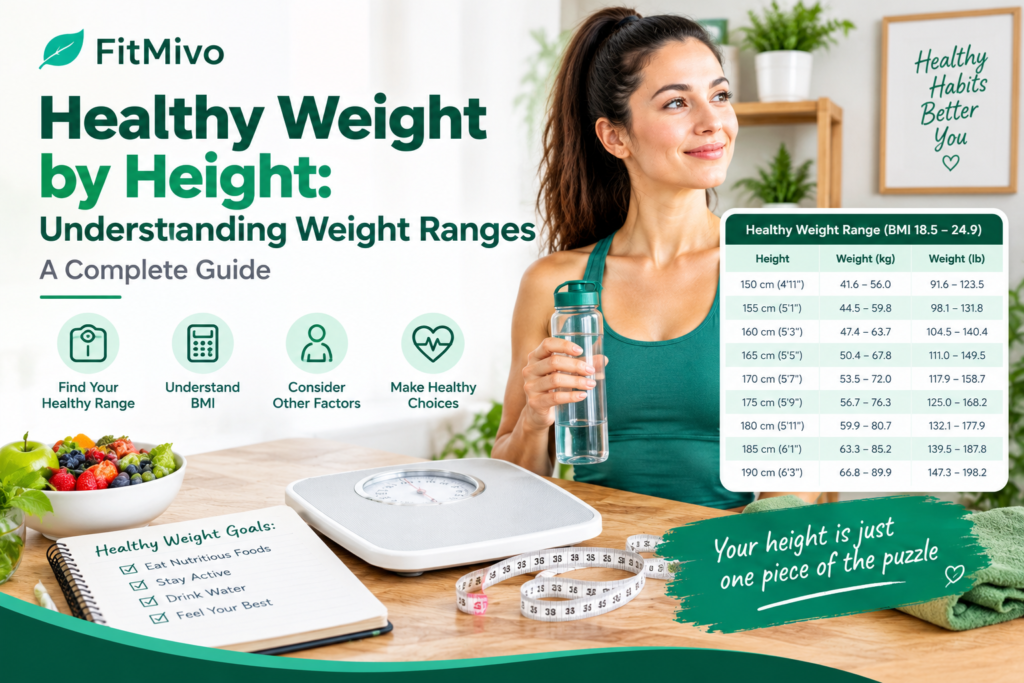
The following chart shows approximate weight ranges corresponding to a BMI of 18.5 to 24.9 for selected adult heights. The figures are estimates, rounded to one decimal place, and are not personalized medical recommendations.
| Height | Approximate healthy-weight range (kg) | Approximate range (lb) |
|---|---|---|
| 150 cm (4 ft 11 in) | 41.6–56.0 kg | 91.6–123.5 lb |
| 155 cm (5 ft 1 in) | 44.5–59.8 kg | 98.1–131.8 lb |
| 160 cm (5 ft 3 in) | 47.4–63.7 kg | 104.5–140.4 lb |
| 165 cm (5 ft 5 in) | 50.4–67.8 kg | 111.0–149.5 lb |
| 170 cm (5 ft 7 in) | 53.5–72.0 kg | 117.9–158.7 lb |
| 175 cm (5 ft 9 in) | 56.7–76.3 kg | 125.0–168.2 lb |
| 180 cm (5 ft 11 in) | 59.9–80.7 kg | 132.1–177.9 lb |
| 185 cm (6 ft 1 in) | 63.3–85.2 kg | 139.5–187.8 lb |
| 190 cm (6 ft 3 in) | 66.8–89.9 kg | 147.3–198.2 lb |
How Does BMI Estimate a Healthy Weight Range?
BMI measures body weight relative to height. It is commonly used as a first screening step because it is simple to calculate and can help identify weight categories that may deserve further assessment.
For adults, the metric formula is:
For example, if an adult weighs 70 kg and is 1.75 meters tall:
BMI = 70 ÷ (1.75 × 1.75) = 22.9
This result falls within the standard healthy-weight BMI category for adults.
You can learn more about the calculation in our guide: What Is BMI? A Complete Guide to Body Mass Index.
Example: Calculating a Healthy Weight Range
Imagine an adult who is 1.70 meters tall. To estimate the weight range corresponding to a BMI of 18.5 to 24.9, use the following calculations:
- Lower estimate: 18.5 × 1.70 × 1.70 = approximately 53.5 kg.
- Upper estimate: 24.9 × 1.70 × 1.70 = approximately 72.0 kg.
The resulting screening range is approximately 53.5 to 72.0 kg. This is a mathematical estimate, not a recommendation that every adult of this height should weigh a particular amount.
Two people of the same height and weight may have different muscle mass, fat distribution, fitness levels, and health conditions. A healthcare professional can help interpret the numbers in context.
Why Height Alone Cannot Determine Your Ideal Weight
Height is useful when estimating weight ranges, but it cannot tell the whole story about health. BMI also has important limitations.
Muscle mass and body composition
Muscle is denser than fat. People who have substantial muscle mass, including some athletes, may have a higher BMI without having excessive body fat. BMI does not distinguish muscle, fat, and bone mass.
Fat distribution
Where fat is stored can matter for health. BMI does not show whether a person carries more fat around the waist. Waist circumference may provide additional information when interpreted appropriately.
Age and life stage
Children and teenagers grow at different rates and need different assessment methods. Pregnancy also changes body weight, so standard adult weight-by-height charts are not designed to assess pregnancy weight.
Individual health conditions
Some medical conditions, medications, and changes in fluid balance can affect body weight. If your weight changes unexpectedly or you have concerns about your health, speak with a qualified healthcare professional.
Factors That Influence a Healthy Weight
A person's weight is influenced by multiple interacting factors. Height is only one part of the picture.
- Genetics: Genetic factors can influence body size, appetite, and how the body stores fat.
- Nutrition: Eating patterns, portion sizes, and overall dietary quality can influence weight and health.
- Physical activity: Movement supports cardiovascular health, strength, mobility, and energy balance.
- Sleep: Sleep quality and duration can affect appetite, energy, and daily habits.
- Medications and health conditions: Certain treatments and conditions can change body weight.
- Stress and environment: Stress, work schedules, food access, and daily routines can affect health behaviors.
For these reasons, a healthy weight goal should be realistic and appropriate for the individual rather than based solely on a chart.
How to Approach a Healthy Weight Goal
If you want to improve your health or change your weight, focus on sustainable habits instead of trying to reach a specific number as quickly as possible.
1. Set a realistic goal
Consider your current health, daily routine, and personal circumstances. A healthcare professional can help you decide whether changing your weight is appropriate and what a reasonable goal might be.
2. Build balanced eating habits
Include a variety of vegetables, fruits, whole grains, protein-rich foods, and other foods that meet your nutritional needs. A balanced approach is generally more sustainable than severe restriction.
3. Stay physically active
Choose activities you can maintain, such as walking, cycling, swimming, or strength training. Adapt your routine to your abilities and any medical advice you have received.
4. Understand your calorie needs
Your energy needs depend on factors such as age, body size, and activity level. Explore these FitMivo guides to learn more:
- How Many Calories Do I Need a Day?
- What Is TDEE? A Complete Guide to Total Daily Energy Expenditure
- What Is BMR? A Complete Guide to Basal Metabolic Rate
5. Track more than the number on the scale
Weight is only one measure of progress. Strength, endurance, sleep, everyday energy, and other health indicators can also be meaningful. Avoid interpreting normal day-to-day weight fluctuations as a complete picture of your health.
When Should You Seek Professional Advice?
Consider speaking with a healthcare professional if you are concerned about being underweight or having excess weight, experience unexplained weight changes, or have a medical condition that affects nutrition or metabolism.
Professional guidance is especially important for children and teenagers, during pregnancy, and for people with a history of disordered eating. A clinician can consider your medical history and other health indicators rather than relying on height and weight alone.
Frequently Asked Questions
1. What is the ideal weight for my height?
There is no single ideal weight for everyone of a given height. For adults, a BMI between 18.5 and less than 25 is commonly used to estimate a healthy-weight range, but individual circumstances matter.
2. Is the healthy weight chart accurate for everyone?
No. The chart provides approximate ranges based on adult BMI categories. It does not directly measure body fat or distinguish muscle from fat, and it cannot independently diagnose a health condition.
3. Does age affect my healthy weight?
Age and life stage can affect how weight should be interpreted. Adult BMI categories are intended for adults aged 20 and older, while children and teenagers require growth-chart assessments. Older adults may also need individualized assessment of muscle, nutrition, and overall health.
4. Can a muscular person have a high BMI?
Yes. Because BMI does not distinguish muscle from fat, a person with substantial muscle mass may have a higher BMI. Other measures and a professional assessment may help provide a clearer picture.
5. Is BMI enough to tell whether I am healthy?
No. BMI is a screening tool, not a diagnosis. Health assessment may also consider waist circumference, blood pressure, laboratory results, medical history, physical activity, and other factors.
6. Should I lose weight if my BMI is above the healthy range?
Not necessarily based on BMI alone. The appropriate next step depends on your overall health, body composition, medical history, and personal circumstances. A healthcare professional can help interpret your result and discuss suitable options.
7. Can I use this chart for children or teenagers?
No. Children and teenagers need age- and sex-specific growth charts. The adult weight ranges in this article should not be used to assess their weight.
8. What is the difference between a healthy weight and an ideal weight?
A healthy weight is a broad concept related to overall health and well-being. “Ideal weight” is often used to describe a single number, but there is no universally correct target for every person of the same height.
Key Takeaways
- Healthy weight ranges depend partly on height, but height alone does not determine health.
- For adults aged 20 and older, a BMI from 18.5 to less than 25 is commonly classified as the healthy-weight range.
- Weight-by-height charts provide estimates rather than personalized medical recommendations.
- BMI does not distinguish muscle from fat or show where body fat is stored.
- Consider overall health, daily habits, and professional advice when setting a weight goal.
Understand Your Body with FitMivo
Explore our health and fitness guides to learn more about BMI, daily calorie needs, metabolism, and sustainable habits.
Sources and Further Reading
- CDC — Adult BMI Categories
- CDC — BMI Frequently Asked Questions
- CDC — About Body Mass Index (BMI)
- NHS — Overweight and Obesity in Adults
Medical disclaimer: This article is for educational purposes only and is not a substitute for individualized medical advice, diagnosis, or treatment. Weight ranges are estimates for adults and may not be suitable for every individual. Consult a qualified healthcare professional if you have concerns about your weight or health.