
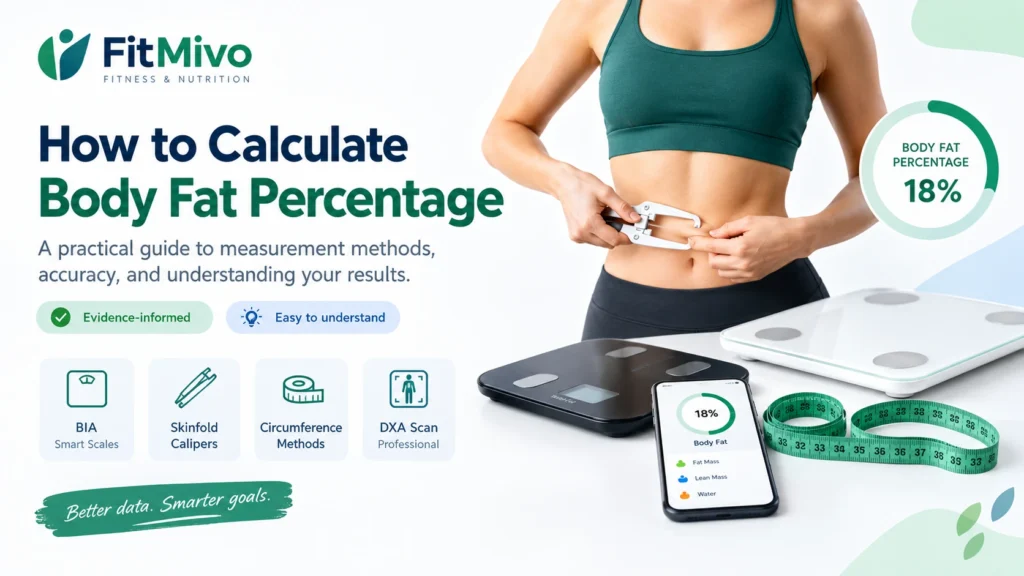
Knowing your body weight is useful, but it does not tell you how much of that weight comes from fat or lean tissue. Body fat percentage offers another way to understand body composition and monitor changes over time.
In this FitMivo guide, you will learn how to calculate body fat percentage, compare common measurement methods, understand their limitations, and interpret your results without relying on a single number.
Quick answer
Body fat percentage estimates the proportion of your total body weight that is fat. It can be estimated using smart scales, skinfold measurements, circumference-based equations, or professional body composition assessments. Each method has limitations, so results should be treated as estimates.
What Is Body Fat Percentage?
Body fat percentage is the percentage of your total body weight that consists of fat tissue. The remaining weight includes lean tissues such as muscles, bones, organs, and body water.
For example, a person weighing 80 kilograms with an estimated body fat percentage of 25% has an estimated fat mass of 20 kilograms.
The basic calculation
Fat mass = Body weight × Body fat percentage ÷ 100
Example: 80 kg × 25 ÷ 100 = 20 kg
This example explains the calculation; it does not establish a recommended body fat percentage.
Why Is Body Fat Percentage Useful?
Body fat percentage can provide information that body weight alone cannot. Two people may have the same weight but different proportions of fat and lean tissue.
Depending on your goals, body composition estimates may help you:
- Monitor longer-term changes during a fitness program.
- Understand why weight alone does not fully describe body composition.
- Track trends alongside strength, endurance, and other fitness measures.
- Discuss body composition with a qualified healthcare professional when appropriate.
However, body fat percentage is not a diagnosis and cannot determine overall health on its own.
How to Calculate Body Fat Percentage
There are several ways to estimate body fat. The most suitable method depends on your budget, access to equipment, reason for measuring, and need for consistency.
1. Bioelectrical Impedance Analysis (BIA)
Many smart scales and handheld devices use bioelectrical impedance analysis. These devices measure how a small electrical current travels through the body and use an algorithm to estimate body composition.
Advantages
- Convenient for home use.
- Usually quick and simple.
- Useful for tracking trends when measurements are taken consistently.
Limitations
- Hydration changes may affect readings.
- Recent exercise and meals can influence some measurements.
- Different brands and devices may produce different estimates.
For better comparisons, follow the manufacturer's instructions and measure under similar conditions each time. Do not interpret every small change as a real change in fat mass.
2. Skinfold Measurements
Skinfold calipers measure the thickness of a fold of skin and underlying fat at selected body sites. Measurements are then entered into an equation to estimate body fat percentage.
This method can be relatively inexpensive, but results depend on the measurement locations, the equation used, and the skill of the person taking the measurements. Consistent technique is important when comparing results over time.
3. Circumference-Based Estimates
Some equations estimate body fat using measurements such as waist circumference, neck circumference, height, and sometimes hip circumference. The required measurements and equations vary by method.
This approach requires little equipment, usually only a measuring tape. However, it is an indirect estimate and may be less suitable for people whose body proportions differ from those represented by the equation.
If you use an online calculator, check which measurements it requires and what method it uses. Different calculators may return different results from the same person.
4. DXA Body Composition Scan
Dual-energy X-ray absorptiometry, commonly called DXA or DEXA, uses low-dose X-rays to estimate bone mineral content, fat mass, and lean soft tissue.
It can provide a more detailed body composition assessment than a standard bathroom scale, but it costs more and requires specialized equipment. It also involves exposure to a small amount of ionizing radiation. Results can vary with equipment and testing procedures.
DXA is not necessary for everyone. A qualified healthcare professional can help determine whether a professional assessment is appropriate for your needs.
Body Fat Measurement Methods Compared
The following table summarizes common options. No method is perfect for every person or purpose.
| Method | Main advantage | Main limitation |
|---|---|---|
| Smart scale (BIA) | Convenient for regular home measurements. | Readings can be affected by hydration and measurement conditions. |
| Skinfold calipers | Relatively inexpensive equipment. | Depends on measurement technique and the equation used. |
| Circumference equations | Requires only a measuring tape. | Provides an indirect estimate that may not fit every body type equally well. |
| DXA scan | Provides a detailed body composition assessment. | Costs more, requires specialized equipment, and uses low-dose X-rays. |
Mobile tip: If the table is wider than your screen, swipe horizontally to read the remaining columns.
What Is a Healthy Body Fat Percentage?
There is no single body fat percentage that defines good health for everyone. Body composition varies with age, sex, genetics, training history, and other individual factors.
Reference ranges may differ between organizations and measurement methods. Ranges designed for athletes should not automatically be applied to the general population.
Very low body fat, especially when caused by inadequate nutrition or excessive exercise, may be associated with health risks. Higher body fat may also be associated with certain health risks, but body fat percentage alone cannot diagnose a condition.
A balanced approach
Use body composition as one piece of information alongside physical activity, nutrition, sleep, strength, energy levels, and overall health. Ask a qualified healthcare professional for individual guidance when needed.
Body Fat Percentage vs. BMI
Body fat percentage and Body Mass Index (BMI) are different measurements.
| Measurement | What it tells you |
|---|---|
| Body fat percentage | Estimates the proportion of body weight that is fat. |
| BMI | Uses height and weight as a screening measure of body size. |
BMI does not directly measure body fat and may not fully reflect body composition in muscular individuals. Body fat estimates also have limitations and vary by method.
Read our related guide: What Is BMI? A Complete Guide to Body Mass Index.
How to Track Body Fat Percentage Consistently
If you choose to monitor body composition, consistent measurement conditions can make comparisons more meaningful.
- Use the same method. Different devices and equations may produce different estimates.
- Measure under similar conditions. Follow your device instructions and use a consistent routine.
- Consider hydration. Fluid balance can affect some measurement methods.
- Look at trends. Avoid reacting to a single reading or a small change.
- Track other indicators. Fitness, strength, energy, and general well-being also matter.
Common Mistakes to Avoid
- Trusting one result completely: Every method has some degree of uncertainty.
- Comparing unrelated devices: Different algorithms can produce different estimates.
- Ignoring measurement conditions: Hydration and recent activity can affect certain readings.
- Chasing an arbitrary number: Appropriate goals differ between individuals.
- Treating the result as a diagnosis: A body fat estimate cannot replace professional medical advice.
Frequently Asked Questions
Can I calculate body fat percentage at home?
Yes. Smart scales, skinfold calipers, and circumference-based equations can provide estimates at home. Their results are not exact, so use them cautiously and consistently.
Which method is the most accurate?
Accuracy depends on the method, equipment, operator, and individual being measured. DXA provides detailed information, while specialized research methods may offer additional precision. No method is perfect in every situation.
Does losing weight always mean losing body fat?
No. Weight changes can reflect changes in body fat, lean tissue, glycogen, and body water. Body weight alone cannot identify exactly what has changed.
How often should I measure body fat?
There is no universal schedule. If you track a fitness goal, occasional measurements under similar conditions may be more useful than frequent checks that encourage you to overinterpret small fluctuations.
Is body fat percentage better than BMI?
They provide different information. Body fat percentage estimates body composition, while BMI is based on height and weight. Neither should be used alone to determine overall health.
Final Thoughts
Body fat percentage can provide useful context about body composition, but the result depends on the method used. Home devices and circumference equations are convenient for tracking trends, while professional assessments may be appropriate when more detailed information is needed.
For a balanced approach to fitness, consider body composition alongside nutrition, physical activity, sleep, strength, and overall well-being. Sustainable habits are more valuable than chasing a single number.
Sources and Further Reading
- Centers for Disease Control and Prevention (CDC): About BMI
- National Institute of Diabetes and Digestive and Kidney Diseases (NIDDK): Weight Management
- MedlinePlus: Assessing Your Weight
- National Heart, Lung, and Blood Institute: Assessing Your Weight and Health Risk
Disclaimer: This article is for educational purposes only and is not a substitute for personalized medical advice. Consult a qualified healthcare professional if you have concerns about body composition, nutrition, or weight management.