
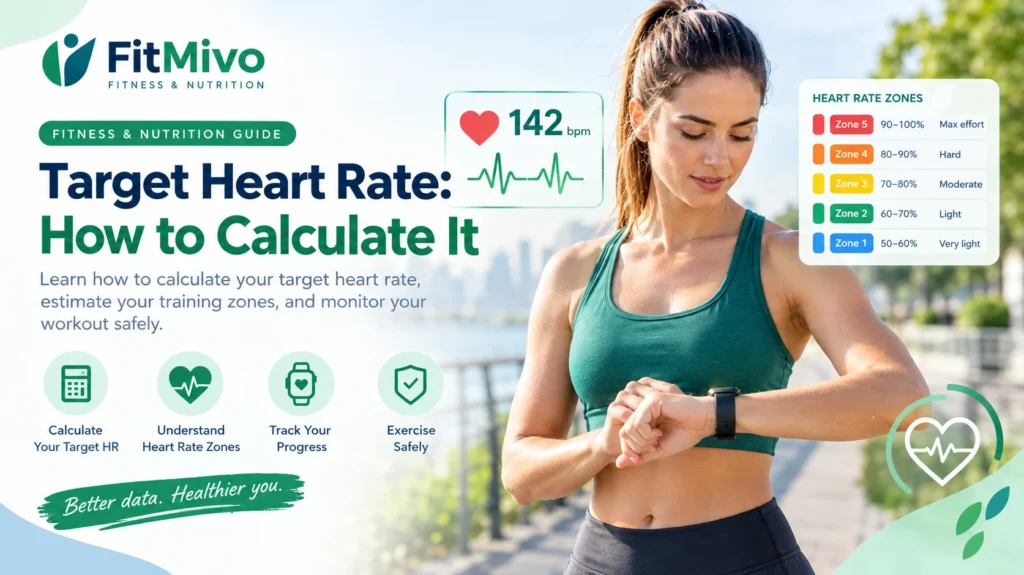
Your heart rate can help you understand how hard your body is working during exercise. Whether you enjoy brisk walking, cycling, running, or strength training, learning about your target heart rate can help you make better decisions about workout intensity.
In this FitMivo guide, you will learn what target heart rate means, how to estimate your training zones, how to measure your pulse, and how to use these numbers as part of a balanced fitness routine.
What Is Target Heart Rate?
Your target heart rate is an estimated range of heartbeats per minute that can help you monitor exercise intensity. It is commonly calculated as a percentage of your estimated maximum heart rate.
Maximum heart rate is the approximate highest number of times your heart may beat per minute during intense exercise. It varies from person to person, so an age-based estimate should be treated as a general guide rather than an exact limit.
How to Calculate Your Maximum Heart Rate
A commonly used estimate is:
Estimated Maximum Heart Rate
220 − Your Age
For example, if you are 30 years old:
- Estimated maximum heart rate = 220 − 30
- Estimated maximum heart rate = 190 beats per minute (bpm)
This formula is simple, but it does not predict every person’s maximum heart rate accurately. Use the result as a starting point, not a strict training limit.
How to Calculate Your Target Heart Rate Zones
The American Heart Association describes moderate-intensity exercise as approximately 50–70% of estimated maximum heart rate, while vigorous-intensity exercise is approximately 70–85%.
To estimate your target zone, multiply your estimated maximum heart rate by the relevant percentages.
Example: A 30-Year-Old Adult
Using an estimated maximum heart rate of 190 bpm:
- Moderate intensity: 190 × 0.50 to 190 × 0.70 = 95–133 bpm
- Vigorous intensity: 190 × 0.70 to 190 × 0.85 = 133–162 bpm
These ranges overlap at the boundary because they use different intensity percentages. Actual exercise intensity depends on fitness, health, medication, and other individual factors.
Target Heart Rate by Age
The table below provides approximate exercise heart rate ranges based on the age-based formula. Values are rounded to the nearest whole beat per minute.
| Age | Estimated Maximum HR | Moderate (50–70%) | Vigorous (70–85%) |
|---|---|---|---|
| 20 | 200 bpm | 100–140 bpm | 140–170 bpm |
| 30 | 190 bpm | 95–133 bpm | 133–162 bpm |
| 40 | 180 bpm | 90–126 bpm | 126–153 bpm |
| 50 | 170 bpm | 85–119 bpm | 119–145 bpm |
| 60 | 160 bpm | 80–112 bpm | 112–136 bpm |
| 70 | 150 bpm | 75–105 bpm | 105–128 bpm |
Important: These are estimates for general educational use, not personalized exercise prescriptions. Your appropriate training intensity may differ from the ranges shown.
What Do Different Exercise Intensities Feel Like?
Moderate-Intensity Exercise
During moderate activity, your breathing and heart rate increase, but you can usually talk comfortably. You may find it harder to sing. Examples include brisk walking, recreational cycling, dancing, and water aerobics.
Vigorous-Intensity Exercise
Vigorous activity requires more effort. You will usually breathe harder and may only be able to say a few words before pausing for breath. Examples can include running, fast cycling, swimming laps, and jumping rope.
These descriptions are useful because the same activity can feel moderate for one person and vigorous for another. The Centers for Disease Control and Prevention explains how the talk test can help people estimate exercise intensity.
How to Measure Your Heart Rate During Exercise
You can monitor your heart rate with a fitness tracker, smartwatch, or by checking your pulse manually.
- Pause or slow down enough to check your pulse safely.
- Place your index and middle fingers on the inside of your wrist, below the base of your thumb.
- Count your beats for 60 seconds, or count for 30 seconds and multiply by two.
- Compare the result with your estimated target range, while considering how you feel.
Wearable devices can make monitoring easier, but their readings may not always be exact. Do not rely on a heart rate number alone to decide whether exercise is safe for you.
Tips for Using Heart Rate Zones in Your Workout
- Start gradually: If you are new to exercise, begin with a comfortable pace and increase your effort over time.
- Choose the right intensity: Many everyday aerobic sessions can be completed at moderate intensity.
- Pay attention to symptoms: Stop exercising if you experience chest pain, faintness, unusual shortness of breath, or other concerning symptoms, and seek appropriate medical care.
- Allow recovery: Rest, sleep, hydration, and recovery days all support a sustainable fitness routine.
- Look beyond the numbers: Your energy, breathing, perceived effort, and recovery also matter.
What Can Affect Your Target Heart Rate?
Your estimated heart rate zones may not reflect your personal limits. Factors that can affect heart rate during exercise include:
- Current fitness level and training experience
- Health conditions and cardiovascular history
- Medications, including some that affect heart rate
- Heat, humidity, stress, illness, and hydration status
- Sleep quality and how hard you have exercised recently
If you have a heart condition, take medication that affects heart rate, are returning to exercise after a long break, or are unsure which intensity is appropriate, ask a qualified healthcare professional for individual guidance.
Frequently Asked Questions
Is a higher heart rate always better during exercise?
No. A higher heart rate generally indicates greater effort, but harder exercise is not always better. The appropriate intensity depends on your goals, fitness, health, and recovery.
Can I exercise effectively without tracking my heart rate?
Yes. You can use the talk test and your perceived effort to estimate intensity. During moderate exercise, you should generally be able to talk but not sing comfortably.
Should beginners aim for the highest target heart rate zone?
Not necessarily. Beginners can start at a comfortable, manageable intensity and gradually build their activity level. Consistency is more important than pushing to a high heart rate.
Does the 220-minus-age formula work for everyone?
No. It is a general estimate, and individual maximum heart rates can differ. Use the formula as a rough reference rather than a precise measurement.
Final Thoughts
Understanding your target heart rate can help you estimate exercise intensity and make your workouts more purposeful. The simple 220-minus-age formula provides a starting point, while the talk test offers another practical way to judge effort.
Remember that heart rate zones are estimates, not rules. Choose an intensity that suits your current fitness and health, increase your activity gradually, and seek professional advice when you need a personalized plan.
Sources
- American Heart Association: Target Heart Rates Chart
- CDC: How to Measure Physical Activity Intensity
- American Heart Association: Physical Activity Recommendations
FitMivo provides educational fitness and wellness information. This article is not a substitute for individualized medical advice.