
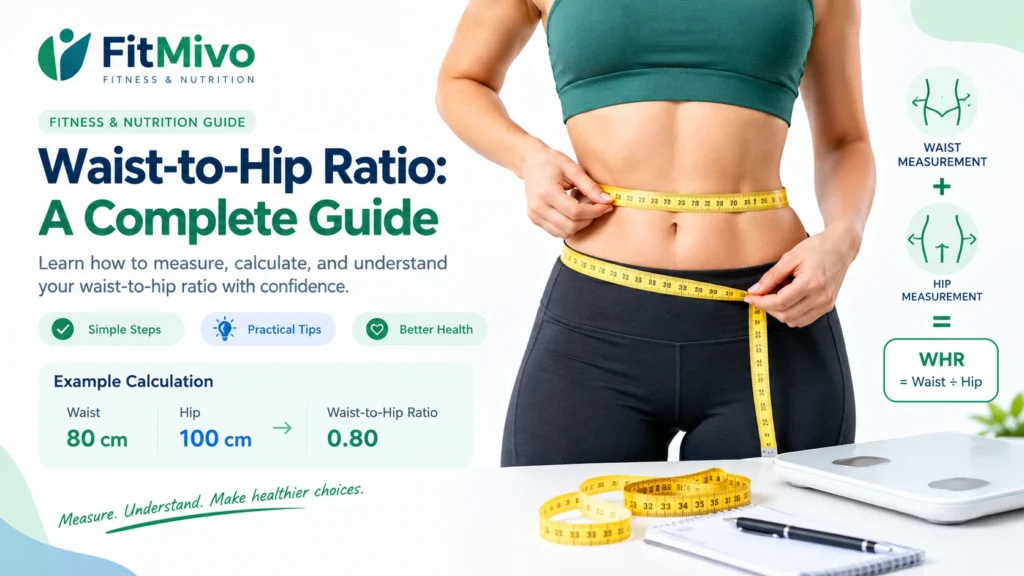
Waist-to-Hip Ratio: A Complete Guide to Measuring and Understanding It
Your body measurements can provide useful information about body shape and fat distribution. One simple measurement is the waist-to-hip ratio (WHR), which compares the circumference of your waist with the circumference of your hips.
In this guide, you will learn how to calculate your waist-to-hip ratio, measure accurately at home, understand general health guidelines, and recognize the limitations of this measurement.
What Is Waist-to-Hip Ratio?
Waist-to-hip ratio is a measurement used to describe how waist size compares with hip size. It can help provide insight into fat distribution, particularly the amount of fat carried around the abdomen relative to the hips.
Researchers and healthcare professionals may use WHR alongside other measurements, such as body mass index (BMI), waist circumference, blood pressure, and blood test results, when assessing health risks.
However, WHR does not directly measure body fat percentage, and it cannot distinguish fat from muscle or determine your overall health by itself.
How to Calculate Waist-to-Hip Ratio
The calculation is straightforward. Measure your waist and hips using the same unit, then divide your waist measurement by your hip measurement.
Waist-to-Hip Ratio Formula
WHR = Waist Circumference ÷ Hip Circumference
Example Calculation
Imagine your waist circumference is 80 cm and your hip circumference is 100 cm.
WHR = 80 ÷ 100 = 0.80
Your waist-to-hip ratio would be 0.80. This is a measurement result, not a diagnosis or a complete assessment of your health.
How to Measure Your Waist and Hips
1. Measure Your Waist
- Stand upright with your abdomen relaxed.
- Place a flexible measuring tape around your waist, approximately midway between the lowest rib and the top of your hip bone.
- Keep the tape horizontal and snug without compressing your skin.
- Breathe normally and take the measurement after a natural exhalation.
- Record the measurement in centimeters or inches.
2. Measure Your Hips
- Stand with your feet together.
- Wrap the measuring tape around the widest part of your hips and buttocks.
- Ensure the tape stays level all the way around.
- Keep the tape snug but do not pull it tightly into your skin.
- Record the measurement using the same unit as your waist measurement.
3. Calculate Your Ratio
Divide the waist measurement by the hip measurement. For better consistency, repeat each measurement and use a reliable reading. If you track your measurements over time, try to measure under similar conditions each time.
Waist-to-Hip Ratio Reference Table
The World Health Organization has published commonly used WHR cut-off points for increased metabolic complication risk. The following table summarizes those general adult reference points.
| Adult group | WHR cut-off | General interpretation |
|---|---|---|
| Women | Above 0.85 | Associated with increased metabolic complication risk |
| Men | Above 0.90 | Associated with increased metabolic complication risk |
Important: These are general reference points, not universal diagnostic boundaries. Health risk varies with age, ethnicity, medical history, and other factors. A healthcare professional can help interpret your measurements in context.
Waist-to-Hip Ratio vs. BMI
WHR and BMI describe different aspects of body size. BMI uses height and weight, while WHR compares waist and hip circumferences.
| Feature | Waist-to-Hip Ratio | Body Mass Index |
|---|---|---|
| Measurements used | Waist and hip circumference | Weight and height |
| Main purpose | Describes fat distribution | Screens weight relative to height |
| Measures body fat directly? | No | No |
For a closer look at BMI, read our complete guide to Body Mass Index. Neither measurement should be used alone to judge an individual’s health.
What Can Affect Your Waist-to-Hip Ratio?
- Measurement technique: Different tape positions can produce different results.
- Body composition: Muscle mass and fat distribution vary from person to person.
- Age and life stage: Body shape can change over time.
- Health and genetics: Individual factors influence body composition and health risk.
- Temporary changes: Bloating and other short-term changes can affect waist measurements.
Can You Improve Your Waist-to-Hip Ratio?
It is not possible to choose exactly where your body loses fat. However, sustainable habits can support overall health and body composition.
- Choose a balanced eating pattern that includes vegetables, fruit, whole grains, protein sources, and healthy fats.
- Build a regular physical activity routine that includes aerobic activity and strength training suitable for your abilities.
- Prioritize consistent sleep and recovery.
- Choose realistic, sustainable goals instead of extreme diets or rapid weight-loss plans.
- Discuss personal health concerns with a qualified healthcare professional.
Your WHR is only one measurement. Progress can also be reflected in fitness, strength, energy, and other health indicators.
Frequently Asked Questions
Is a lower waist-to-hip ratio always better?
Not necessarily. WHR must be interpreted in context, and a single number cannot determine overall health. Extremely low measurements are not automatically evidence of better health.
Can I calculate WHR in inches?
Yes. You can use inches or centimeters as long as both measurements use the same unit.
How often should I measure my waist-to-hip ratio?
There is no single schedule that suits everyone. If you choose to track it, measuring occasionally under consistent conditions is more useful than reacting to daily changes.
Is waist-to-hip ratio accurate?
It can be useful when measurements are taken consistently, but errors in tape placement and individual differences can affect the result. It is a screening measure rather than a direct measurement of body fat or a diagnosis.
Final Thoughts
Waist-to-hip ratio is a simple way to compare waist and hip measurements and learn more about body fat distribution. Measure carefully, use the same units, and interpret the result alongside other health information rather than treating it as a complete picture of your health.
At FitMivo, our goal is to make health and fitness information easier to understand so you can make informed decisions and build sustainable habits.
Sources
- World Health Organization: Waist Circumference and Waist-Hip Ratio
- CDC: About Healthy Weight and Growth
- NIDDK: Weight Management
Disclaimer: This article is for educational purposes only and is not a substitute for professional medical advice, diagnosis, or treatment.