
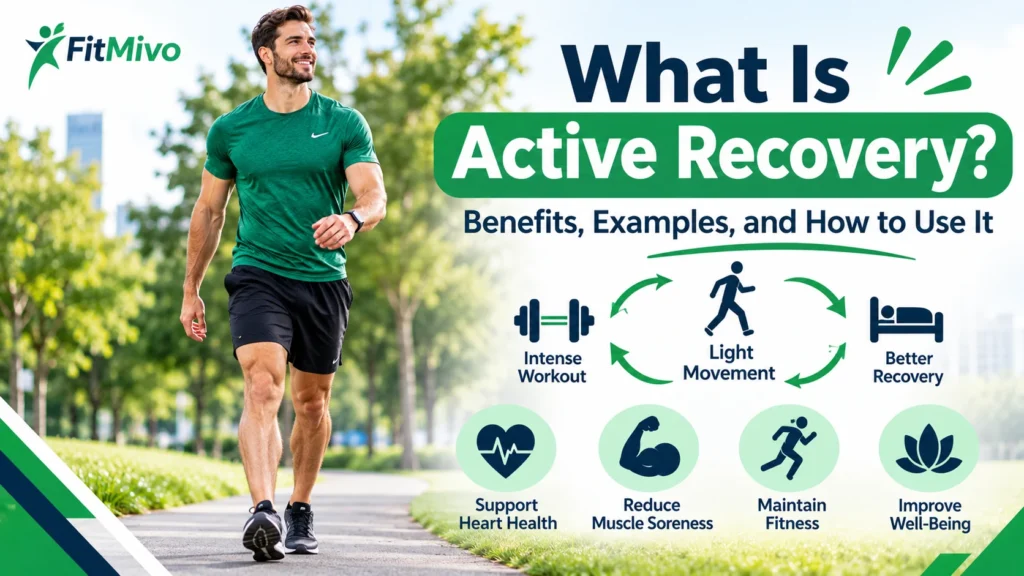
Taking a break from intense exercise does not always mean spending the entire day sitting or lying down. Sometimes, gentle movement can be a useful way to stay comfortable and maintain a balanced fitness routine.
This approach is known as active recovery. It involves performing low-intensity physical activities between demanding workouts or after an intense exercise session.
But what exactly is active recovery? Which activities are suitable, and how can you tell whether you need light movement or complete rest?
In this guide, we explain what active recovery means, its potential benefits, practical examples, and how to include it in your weekly training schedule.
What Is Active Recovery?
Active recovery refers to gentle physical activity performed during periods when your body would otherwise be resting after exercise.
Unlike a regular workout, an active recovery session is not designed to improve performance through high training intensity. Instead, it focuses on comfortable movement that does not create substantial additional fatigue.
For example, someone who performs a demanding strength workout may choose an easy walk or gentle cycling session the following day instead of another intense workout.
The key difference is intensity. Active recovery should feel considerably easier than your normal training sessions.
Active Recovery vs. Passive Recovery
There are two common ways to approach recovery: active recovery and passive recovery.
| Feature | Active Recovery | Passive Recovery |
|---|---|---|
| Activity | Gentle movement | Rest without planned exercise |
| Examples | Walking, easy cycling, gentle swimming | Relaxing, sleeping, taking a break |
| Intensity | Very low | No planned exercise |
| Main purpose | Maintain comfortable movement | Allow physical and mental rest |
Neither approach is automatically better. Your choice should depend on your energy, soreness, training demands, and overall health.
What Are the Benefits of Active Recovery?
When performed at an appropriate intensity, active recovery can offer several practical benefits.
1. Helps Maintain Comfortable Movement
After a demanding workout, some people experience stiffness or feel less comfortable moving around. Gentle activities such as walking or easy cycling can help maintain normal movement without requiring another challenging training session.
2. Supports a Consistent Fitness Routine
Recovery days do not have to mean abandoning all physical activity. Light movement can help some people maintain a regular routine while allowing a break from demanding workouts.
3. Provides a Break From Repetitive Training
Repeating the same demanding activity without enough recovery can create unnecessary fatigue. Choosing a different, easier activity gives you an opportunity to reduce the training load.
For example, a person who regularly performs muscular endurance exercises may choose a relaxed walk instead of another demanding session involving the same muscle groups.
4. May Help Reduce the Feeling of Stiffness
Gentle movement can make some people feel less stiff after exercise. However, this does not mean active recovery eliminates muscle damage or guarantees faster physical recovery.
5. Encourages Better Training Balance
Successful fitness routines involve more than exercise intensity. They also require appropriate rest, nutrition, sleep, and adjustments to training volume.
Active recovery can be one part of a balanced approach that helps you avoid treating every training day as an opportunity to push harder.
Best Active Recovery Exercises
The best active recovery activities are generally simple, comfortable, and easy to control. You do not need special equipment or an advanced fitness level.
1. Walking
Walking is one of the simplest active recovery options. You can choose a comfortable pace outdoors, around your neighborhood, or on a treadmill.
Keep the pace relaxed rather than turning the walk into a demanding cardio session.
2. Easy Cycling
Light cycling can provide gentle movement while allowing you to control your speed and resistance.
Choose a comfortable setting and avoid challenging hills, high resistance, or intense intervals.
3. Gentle Swimming
Swimming at an easy pace can be another option for people who enjoy water-based activities. Keep the session relaxed and avoid turning it into a competitive or high-intensity workout.
4. Gentle Yoga
Some forms of gentle yoga involve controlled movements, comfortable positions, and relaxed breathing. These sessions may help you maintain mobility without adding a large training load.
If you want to learn more about mobility and movement range, read our guide to understanding flexibility and how to improve it.
5. Light Mobility Exercises
Simple mobility movements can help you move your joints through comfortable ranges of motion.
Examples include:
- Gentle shoulder circles
- Controlled hip rotations
- Easy ankle movements
- Comfortable trunk rotations
- Gentle bodyweight movements
Avoid forcing a movement or pushing into pain.
6. Easy Cycling or Walking After a Workout
A short period of low-intensity movement at the end of a workout can serve as a cool-down. For example, you might walk slowly for a few minutes after running rather than stopping suddenly.
How Intense Should Active Recovery Be?
Intensity is one of the most important parts of active recovery.
The activity should feel easy enough that you can speak comfortably without struggling to catch your breath. You should finish feeling the same or better than when you started, not exhausted.
One useful way to think about intensity is the Rate of Perceived Exertion (RPE). During active recovery, the effort should generally remain near the low end of your personal exertion scale.
For a deeper explanation, read our guide: What Is RPE? A Guide to Measuring Workout Intensity.
- You can hold a normal conversation.
- Your breathing remains comfortable.
- You are not struggling to maintain the activity.
- You do not feel increasingly exhausted.
How Long Should an Active Recovery Session Last?
There is no single duration that works for everyone. The appropriate length depends on your fitness level, the activity you choose, and how you feel.
For many people, a short session of approximately 10 to 30 minutes can be a practical starting point. Some may prefer less, while others may comfortably do a little more.
Remember that the goal is not to reach a particular number of minutes. The goal is to keep the activity light and avoid adding unnecessary fatigue.
When Should You Use Active Recovery?
Active recovery can fit into different parts of a training routine.
After a Demanding Workout
Some people prefer a few minutes of easy walking or cycling after a challenging session. This can provide a gradual transition from exercise to rest.
Between Training Days
If you exercise regularly, you may choose a light activity on a day between demanding workouts.
For example, after a session focused on muscular endurance or muscular strength, you could choose a relaxed walk rather than repeating the same challenging exercises.
During a Busy Week
If you cannot fit in a full workout, a short walk or another comfortable activity may help you remain physically active without trying to force an intense session into an already demanding day.
Example of a Weekly Active Recovery Schedule
The following example shows how active recovery might fit into a general fitness routine. It is an illustration, not a training prescription for every individual.
| Day | Activity |
|---|---|
| Monday | Strength training |
| Tuesday | Easy walking or gentle cycling |
| Wednesday | Moderate cardio workout |
| Thursday | Rest or light mobility |
| Friday | Strength training |
| Saturday | Relaxed swimming or walking |
| Sunday | Rest |
This schedule includes both active recovery and complete rest. You can adjust the activities and frequency according to your experience, goals, and recovery needs.
Active Recovery vs. a Regular Workout
It is easy to confuse active recovery with a light workout. Although they may involve similar activities, their purposes are different.
| Factor | Active Recovery | Regular Workout |
|---|---|---|
| Main goal | Comfortable movement | Fitness improvement |
| Intensity | Very low | Varies by training plan |
| Effort | Easy and comfortable | May be moderate or challenging |
| Expected fatigue | Minimal additional fatigue | Depends on training load |
If your recovery session becomes a challenging workout, it is no longer serving the same purpose.
When Is Complete Rest Better?
Active recovery is not appropriate for every situation. Sometimes, the best decision is to stop exercising and allow your body to rest.
Consider choosing complete rest rather than active recovery if you:
- Feel unusually exhausted.
- Have significant muscle soreness that affects normal movement.
- Are sick or have a fever.
- Have an injury or pain that becomes worse with movement.
- Have not recovered from several demanding training sessions.
- Feel dizzy, unusually weak, or unwell.
Ordinary muscle soreness after unfamiliar exercise is not the same as an injury. However, sharp pain, severe swelling, unusual weakness, or persistent symptoms should not be ignored. Seek appropriate medical advice when needed.
For more information about post-exercise soreness, consult the American College of Sports Medicine guide to delayed-onset muscle soreness (DOMS).
Common Active Recovery Mistakes
1. Making the Session Too Intense
The biggest mistake is turning an easy recovery session into another demanding workout. Keep the pace and effort low.
2. Ignoring Pain
Active recovery should feel comfortable. Do not use it as a reason to exercise through an injury or worsening pain.
3. Skipping Complete Rest
Light movement can be useful, but it does not replace the need for adequate rest. Some days, doing nothing strenuous is the better choice.
4. Following the Same Routine Every Day
Your recovery needs can change depending on training intensity, sleep, stress, and general health. Adjust your activity rather than following a rigid schedule.
5. Expecting Immediate Results
Active recovery is not a guaranteed shortcut to faster muscle repair or improved performance. It is one optional strategy for managing movement and training stress.
How Active Recovery Fits Into Long-Term Progress
Improving fitness requires an appropriate balance between training stress and recovery.
For example, progressive overload involves gradually adjusting training demands over time. However, increasing the challenge without allowing enough recovery can make a routine difficult to maintain.
Active recovery can complement a structured training plan by providing opportunities for easier movement between demanding sessions. It should support your overall routine, not become another source of pressure.
If your goal is to improve strength, endurance, or flexibility, remember that progress depends on consistency, appropriate training, and sufficient recovery.
Frequently Asked Questions About Active Recovery
What is active recovery?
Active recovery is low-intensity physical activity performed after demanding exercise or between training sessions. Common examples include walking, easy cycling, gentle swimming, and relaxed mobility work.
Is active recovery better than complete rest?
Not always. Active recovery may be comfortable and useful for some people, while complete rest is more appropriate when someone is exhausted, sick, injured, or experiencing significant pain.
How long should active recovery last?
There is no universal duration. A short session of around 10 to 30 minutes may be a practical starting point, provided the activity remains comfortable and does not create additional fatigue.
Can walking count as active recovery?
Yes. Walking at an easy, comfortable pace is one of the simplest examples of active recovery.
Can I do active recovery every day?
Gentle everyday movement may be suitable for many people, but it should not replace recovery from demanding training. Your activity level should reflect your health, fitness, and energy.
Does active recovery help with muscle soreness?
Gentle movement may help some people feel less stiff or more comfortable. However, it does not guarantee faster muscle repair or eliminate delayed-onset muscle soreness.
Should I do active recovery after strength training?
You can include easy movement after strength training if it feels comfortable. The session should remain light and should not interfere with your recovery.
Can beginners use active recovery?
Yes. Beginners can choose simple activities such as relaxed walking or gentle mobility exercises. The intensity should match their current fitness level.
Final Takeaway
Active recovery is a practical way to include gentle movement between demanding workouts. Walking, easy cycling, swimming, and comfortable mobility exercises are all possible options.
However, active recovery is not a replacement for sleep, proper nutrition, or complete rest when your body needs it. The best approach is to adjust your activity according to how you feel and the demands of your training routine.
Remember: fitness progress is not about pushing hard every day. It is about finding a sustainable balance between exercise, recovery, and consistency.
Build a More Balanced Fitness Routine
Explore more FitMivo guides to understand training intensity, strength, endurance, and movement:
Sources and Further Reading
- Cleveland Clinic – How to Make the Most Out of Active Recovery
- UCLA Health – How Often Should You Take a Rest Day?
- American College of Sports Medicine – Delayed-Onset Muscle Soreness
- NHS Inform – How to Reduce Your Risk of Injury From Exercise
Disclaimer: This article is for general educational purposes only and is not a substitute for individual medical advice. If you have an injury, ongoing pain, or a medical condition that affects exercise, consult a qualified healthcare professional before changing your activity routine.