
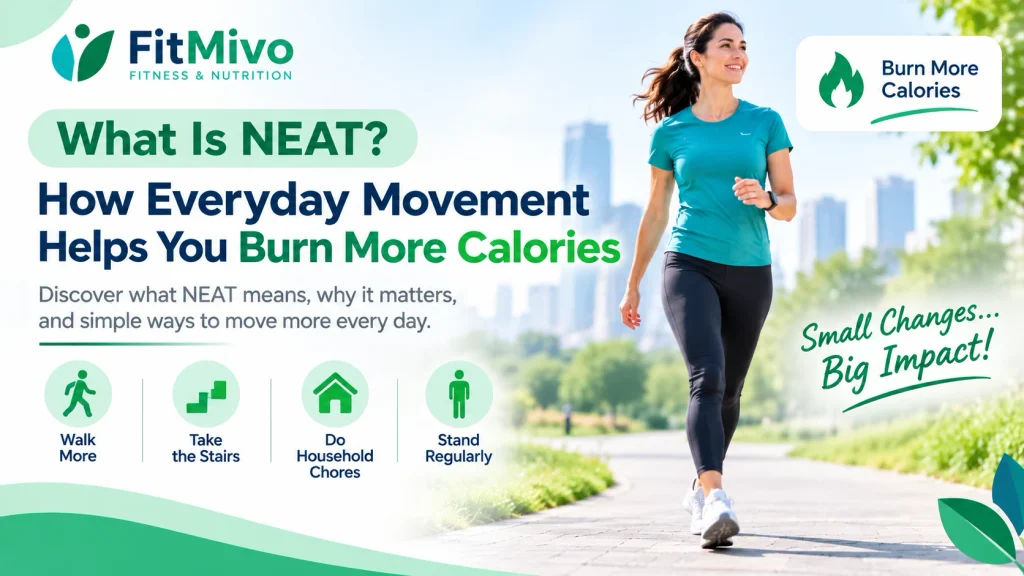
When people think about burning calories, they usually imagine running, cycling, or spending time at the gym. However, physical activity does not always have to involve a structured workout.
Everyday movements such as walking around the house, climbing stairs, cleaning, standing, and even moving while sitting can contribute to the number of calories your body burns throughout the day.
This type of energy expenditure is known as NEAT (Non-Exercise Activity Thermogenesis). It is an important part of daily energy expenditure and can make a meaningful difference in how active you are outside your workouts.
In this guide, you will learn what NEAT means, how it works, why it matters for weight management, and how to increase your daily movement without spending hours at the gym.
What Is NEAT?
NEAT stands for Non-Exercise Activity Thermogenesis. It refers to the energy your body uses for everyday physical activities that are not considered formal exercise, sleeping, or eating.
In simple terms, NEAT includes the calories you burn through normal daily movements that happen outside planned workouts.
Examples of NEAT activities include:
- Walking around your home or workplace.
- Standing instead of sitting for long periods.
- Climbing stairs.
- Cleaning, cooking, and doing household chores.
- Walking while talking on the phone.
- Gardening and other everyday tasks.
- Moving your hands or tapping your feet while sitting.
Although these activities may seem small, they can add up over the course of an entire day.
What Is the Difference Between NEAT and Exercise?
NEAT and exercise both contribute to physical activity, but they are not the same thing.
Exercise usually involves planned, structured, and repetitive movements designed to improve fitness, strength, or endurance. NEAT includes the ordinary movements you perform throughout your daily routine.
| Activity Type | Examples |
|---|---|
| NEAT | Walking to work, cleaning, standing, gardening, taking the stairs. |
| Exercise | Running, swimming, weightlifting, cycling, planned workouts. |
| Resting Energy | Energy used for essential body functions while resting. |
Both NEAT and structured exercise are valuable. Increasing everyday movement does not mean you should replace your regular workouts.
How Does NEAT Affect Daily Calorie Burn?
Your body uses energy throughout the day, even when you are not exercising. Total Daily Energy Expenditure (TDEE) represents the total number of calories your body burns in a 24-hour period.
It includes several components:
- Basal Metabolic Rate (BMR): The energy needed to maintain essential functions such as breathing, circulation, and temperature regulation.
- Thermic Effect of Food (TEF): The energy used to digest, absorb, and process food.
- Exercise Activity: The energy used during planned physical activities and workouts.
- NEAT: The energy used for everyday movements outside formal exercise.
The contribution of NEAT varies considerably between individuals. Someone who spends much of the day walking, standing, or doing physical tasks may have a different daily energy expenditure from someone who spends most of the day sitting.
This is one reason why two people with similar body measurements may have different daily calorie needs.
To understand the relationship between these energy components, read our guide: What Is TDEE? A Complete Guide to Total Daily Energy Expenditure.
Why Is NEAT Important for Weight Management?
NEAT can be an important part of a balanced approach to managing body weight because it contributes to your overall daily energy expenditure.
1. It Increases Daily Movement
You do not need to schedule a workout every time you want to become more active. Simple choices, such as taking the stairs or walking during a break, help you move more throughout the day.
2. It Supports Energy Balance
Weight management is influenced by the relationship between the energy you consume through food and the energy your body uses.
Because NEAT contributes to total energy expenditure, changes in everyday activity can influence your overall energy balance.
3. It Helps Reduce Sedentary Time
Spending long periods sitting can limit daily movement. Adding short periods of standing and walking throughout the day is a practical way to become less sedentary.
4. It Makes Physical Activity Easier to Maintain
Many everyday movements do not require special equipment, a gym membership, or a complicated schedule. This makes NEAT a practical way to build more movement into your lifestyle.
How to Increase NEAT: 10 Simple Everyday Strategies
You do not need to change your entire lifestyle to become more active. Start with small habits that fit naturally into your daily routine.
1. Walk More During the Day
Choose walking for short trips whenever practical. You can also take a short walk after meals or during your breaks.
2. Take the Stairs
When appropriate and safe, choose stairs instead of elevators. This adds movement to activities you already perform.
3. Stand Up Regularly
If you work at a desk, take regular breaks from sitting. Stand, stretch, or walk around for a few minutes.
4. Walk While Talking on the Phone
Instead of remaining seated during every phone call, consider walking around when your surroundings allow it.
5. Do More Household Chores
Cleaning, washing dishes, organizing rooms, and doing laundry are practical ways to add movement to your day.
6. Park a Little Farther Away
When it is safe and convenient, park slightly farther from your destination to add a few extra walking minutes.
7. Choose Active Breaks
Replace some screen-time breaks with light movement, such as walking, stretching, or tidying your workspace.
8. Spend Time Gardening
Gardening involves standing, walking, bending, and other movements that contribute to everyday activity.
9. Make Social Activities More Active
Consider walking with friends or family instead of always choosing activities that involve sitting.
10. Track Your Daily Steps
A phone or fitness tracker can help you understand your current activity level and monitor gradual improvements.
NEAT and Different Lifestyles
Your daily routine has a significant influence on how much non-exercise movement you perform.
| Lifestyle | Typical Daily Activities | Potential NEAT Level |
|---|---|---|
| Desk-based worker | Mostly sitting, computer work, occasional walking. | Lower |
| Mixed-activity lifestyle | Some walking, standing, household tasks. | Moderate |
| Physically active worker | Frequent walking, standing, and physical tasks. | Higher |
These are general examples, not scientific NEAT categories. Actual energy expenditure depends on factors such as body size, movement intensity, duration, and individual characteristics.
Can You Calculate How Many Calories NEAT Burns?
There is no single NEAT calorie value that applies to everyone.
Estimating NEAT accurately is difficult because it includes many different movements throughout the day. Body weight, activity duration, movement intensity, occupation, and individual differences all influence energy expenditure.
Fitness trackers may provide useful estimates of activity, but their calorie readings are not exact measurements of NEAT.
For a broader understanding of your daily calorie needs, you can use the FitMivo TDEE guide and explore our fitness calculators.
Remember that NEAT is only one component of your daily energy expenditure. It should not be treated as a guaranteed calorie-burning target.
NEAT vs. BMR vs. TDEE: Understanding the Difference
These three terms are closely related, but they describe different aspects of energy expenditure.
| Term | Meaning |
|---|---|
| BMR | Energy required to maintain basic body functions at rest. |
| NEAT | Energy used for everyday movement outside formal exercise. |
| TDEE | Total energy your body uses throughout the day. |
Understanding these concepts can help you make more informed decisions about nutrition, physical activity, and weight management.
Frequently Asked Questions About NEAT
What does NEAT stand for?
NEAT stands for Non-Exercise Activity Thermogenesis. It describes the energy your body uses for everyday physical activities outside formal exercise, sleeping, and eating.
Does walking count as NEAT?
Yes. Walking for transportation, during work breaks, or around your home generally counts as NEAT when it is not part of a structured exercise session.
Can NEAT help with weight loss?
NEAT can support weight management by contributing to total daily energy expenditure. However, weight loss also depends on food intake, overall activity, and other individual factors.
Is NEAT more important than exercise?
No. NEAT and structured exercise serve different purposes. Everyday movement supports an active lifestyle, while planned exercise can improve cardiovascular fitness, strength, and endurance. Both are valuable.
How can I increase NEAT if I work at a desk?
Try standing during appropriate tasks, taking short walking breaks, using stairs, and walking while making phone calls. Small changes throughout the day can help reduce sedentary time.
Does standing burn more calories than sitting?
Standing generally uses slightly more energy than sitting, although the difference varies. Walking and other movements usually involve greater energy expenditure than simply standing still.
Can a fitness tracker measure NEAT?
Fitness trackers can estimate steps, movement, and activity levels. However, they cannot measure NEAT calories with perfect accuracy.
Final Thoughts
NEAT is an often-overlooked part of daily energy expenditure. From walking and climbing stairs to cleaning and standing, everyday movements contribute to the energy your body uses.
You do not need to spend every day in the gym to become more active. Building small movement habits into your routine can help reduce sedentary time and support your overall health and weight-management goals.
The key is consistency. Start with simple changes, find activities that fit your lifestyle, and gradually make movement a natural part of your day.
Scientific Sources and Further Reading
- Non-Exercise Activity Thermogenesis in Human Energy Homeostasis – Endotext / NCBI
- Nonexercise Activity Thermogenesis: Environment and Biology – PubMed
- Benefits of Physical Activity – CDC
- Adult Physical Activity Guidelines – CDC
Medical Disclaimer: This article is for educational purposes only and does not replace professional medical advice. Individual activity needs vary depending on age, health status, physical ability, and personal circumstances. Consult a qualified healthcare professional before making significant changes to your exercise routine, especially if you have an existing medical condition.