
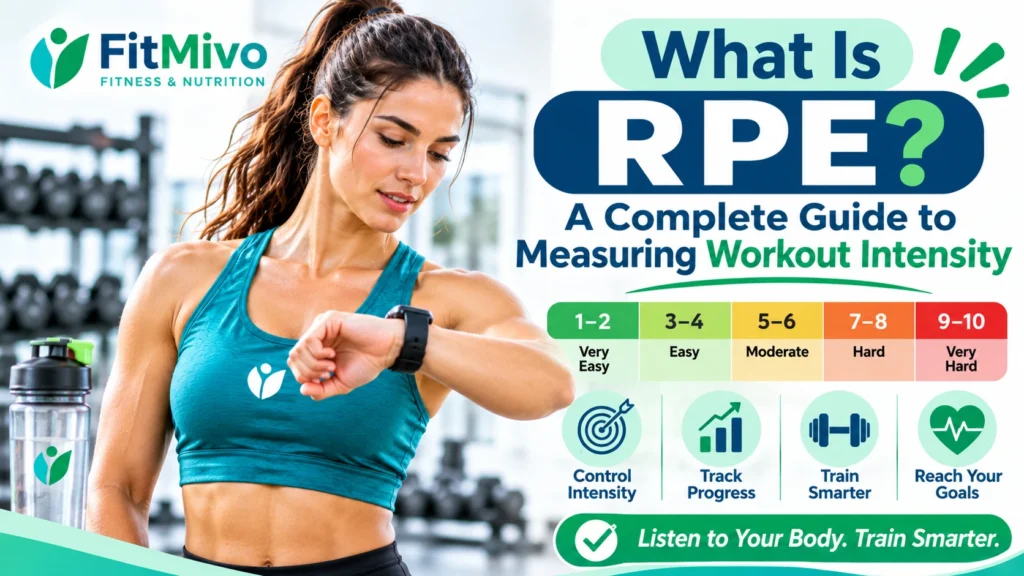
This is where RPE comes in. RPE, or Rate of Perceived Exertion, is a simple method used to measure how difficult physical activity feels to you.
Instead of relying entirely on heart rate monitors, fitness watches, or fixed training weights, RPE helps you evaluate your effort based on your own physical experience.
Whether you lift weights, run, cycle, or perform general fitness exercises, understanding RPE can help you manage workout intensity and make more informed training decisions.
In this guide, you will learn what RPE means, how the different scales work, how to use them during exercise, and how to incorporate RPE into your fitness routine.
What Is RPE?
RPE stands for Rate of Perceived Exertion. It is a subjective measurement of how difficult an exercise or physical activity feels.
When using RPE, you evaluate your effort by considering factors such as:
- How hard your muscles are working.
- How quickly you are breathing.
- How tired you feel during exercise.
- How difficult it is to continue the activity.
- How much effort is required to complete another repetition.
For example, walking at a comfortable pace may feel easy, while running uphill may feel extremely challenging.
RPE allows you to describe these differences using a numerical scale.
RPE is based on how exercise feels to you, not simply how much weight you lift or how fast you move. The same workout can feel different depending on your fitness level, sleep, stress, and recovery.
Why Is RPE Important in Fitness?
RPE is useful because it gives you a practical way to monitor exercise intensity without requiring expensive equipment.
1. Helps Control Workout Intensity
RPE can help you decide whether an exercise session is easy, moderate, or challenging.
This makes it easier to adjust your effort according to your current physical condition.
2. Supports Better Training Decisions
Your energy and performance can change from one workout to another.
Instead of following the same intensity regardless of how you feel, RPE allows you to make adjustments when necessary.
3. Helps Monitor Training Fatigue
If a workout that normally feels manageable suddenly feels extremely difficult, it may be useful to review your recent training load and recovery.
RPE can provide additional information about how your body is responding to exercise.
4. Works Without Special Equipment
You do not need a smartwatch, heart rate monitor, or fitness machine to use RPE.
All you need is an understanding of the scale and some practice evaluating your effort.
5. Can Be Used in Different Activities
RPE can be applied to many forms of physical activity, including:
- Strength training.
- Running and jogging.
- Cycling.
- Swimming.
- Walking.
- Group fitness classes.
Understanding the RPE Scale
There are different RPE scales used in exercise science and fitness training. Two commonly used approaches are the 0–10 scale and the original Borg 6–20 scale.
The appropriate scale depends on the type of exercise and the purpose of the assessment.
1. The 0–10 RPE Scale
The 0–10 scale is a simple way to rate how difficult aerobic exercise feels.
It ranges from complete rest to maximum effort.
| RPE | Effort Level | Description |
|---|---|---|
| 0 | Rest | No physical effort. |
| 1–2 | Very Easy | Comfortable movement with little effort. |
| 3–4 | Moderate | Noticeable effort, but manageable. |
| 5–6 | Hard | Breathing becomes heavier and effort increases. |
| 7–8 | Very Hard | High effort and difficult to sustain. |
| 9–10 | Near Maximum / Maximum | Extremely demanding or maximum effort. |
For aerobic exercise, the American College of Sports Medicine (ACSM) identifies approximately RPE 3–4 as moderate intensity and RPE 5–7 as vigorous intensity on its 0–10 scale.
2. The Borg 6–20 Scale
The original Borg Rating of Perceived Exertion scale uses numbers from 6 to 20.
It was developed to help individuals describe their perceived effort during physical activity.
| Rating | Description |
|---|---|
| 6 | No exertion |
| 7–8 | Extremely light |
| 9–10 | Very light |
| 11–12 | Light |
| 13–14 | Somewhat hard |
| 15–16 | Hard |
| 17–18 | Very hard |
| 19–20 | Extremely hard / maximum |
The Borg scale is commonly used in exercise testing and clinical or rehabilitation settings.
Important: The 0–10 scale and Borg 6–20 scale are different systems. Their numbers should not be treated as interchangeable.
What Does RPE Mean in Weight Training?
RPE is also widely used in resistance training to estimate how close a set is to muscular failure.
In this context, a 1–10 scale is commonly used, with higher values representing greater effort.
For example, a set of squats that feels challenging but still allows you to perform a few additional repetitions would receive a lower RPE than a set completed close to your maximum capacity.
Understanding RPE and Repetitions in Reserve (RIR)
RIR stands for Repetitions in Reserve. It estimates how many additional repetitions you could perform before reaching muscular failure.
RPE and RIR are closely related in common resistance-training systems.
| RPE | Estimated RIR | Meaning |
|---|---|---|
| 10 | 0 | No additional repetitions possible. |
| 9 | 1 | Approximately one repetition remaining. |
| 8 | 2 | Approximately two repetitions remaining. |
| 7 | 3 | Approximately three repetitions remaining. |
| 6 | 4 | Approximately four repetitions remaining. |
| 5 or lower | 5+ | Relatively easy set with several repetitions remaining. |
These are approximate estimates used in common RPE-based resistance-training systems. Actual effort can be difficult to judge, particularly for beginners.
If you complete 10 repetitions of an exercise and believe you could perform two more repetitions with proper technique, your estimated effort would be RPE 8 in this system.
The goal is to understand how challenging each set feels, not to reach RPE 10 every time you exercise.
How to Use RPE During Your Workouts
You can start using RPE without changing your entire training program.
Follow these practical steps to become more familiar with the scale.
1. Learn to Recognize Different Effort Levels
During exercise, pay attention to how your body responds.
Ask yourself:
- Can I comfortably continue this activity?
- Is my breathing becoming noticeably heavier?
- How difficult is the current set?
- Could I complete additional repetitions with good technique?
2. Rate Your Effort After Each Set
After completing a resistance-training set, estimate how difficult it was using the appropriate resistance-training RPE scale.
For cardio, assess your overall effort during the activity using the 0–10 aerobic scale.
3. Adjust the Training Load When Necessary
If your target is RPE 7 but the set feels like RPE 9, consider reducing the weight or adjusting the repetitions in your next set.
If the exercise feels easier than expected, you may gradually increase the challenge when appropriate.
4. Record Your Results
Keeping a simple training log can help you understand how your perceived effort changes over time.
Record information such as:
- Exercise name.
- Weight used.
- Number of sets and repetitions.
- Estimated RPE.
- General notes about fatigue or recovery.
5. Review Your Progress
Over time, compare your training records to identify patterns.
For example, if the same weight and number of repetitions gradually feel easier, this may indicate that your ability to perform the exercise has improved.
How to Use RPE for Cardio Training
RPE is not limited to strength training. It can also help you control the intensity of aerobic exercise.
For example, consider a walking or running session.
| Activity | Example RPE | Perceived Effort |
|---|---|---|
| Easy walking | 1–2 | Comfortable and relaxed. |
| Brisk walking | 3–4 | Moderate effort. |
| Steady jogging | 4–6 | Noticeably challenging. |
| Fast running | 7–8 | Very demanding. |
| Maximum effort | 9–10 | Extremely difficult. |
These examples are illustrative. Your actual RPE will depend on your fitness level, speed, terrain, temperature, and other conditions.
Use the Talk Test Alongside RPE
The talk test is another simple method for evaluating aerobic exercise intensity.
- Easy intensity: You can speak comfortably without noticeable difficulty.
- Moderate intensity: You can talk, but singing would be difficult.
- Vigorous intensity: You can generally say only a few words before needing a breath.
Combining the talk test with RPE can help you develop a better understanding of how hard you are exercising.
What Is a Good RPE for Different Fitness Goals?
There is no single ideal RPE for every workout. The appropriate effort depends on your training experience, exercise type, goals, and recovery.
The following table provides general examples for resistance training.
| Training Situation | Example RPE | Purpose |
|---|---|---|
| Technique practice | 5–6 | Practice controlled movement. |
| Moderate strength training | 6–8 | Challenging work with repetitions remaining. |
| High-effort training | 8–9 | Work close to muscular failure. |
| Maximum effort | 10 | No additional repetition possible. |
These are examples rather than mandatory targets. Beginners should prioritize technique and gradually learn to estimate their effort.
Factors That Can Affect Your RPE
The same exercise can feel different depending on several physical and environmental factors.
1. Sleep Quality
Insufficient sleep may affect energy, concentration, and how difficult exercise feels.
2. Training Experience
People who are familiar with an exercise may be better at estimating how many repetitions they have left than beginners.
3. Stress and Mental Fatigue
Psychological stress and mental fatigue can influence perceived effort during exercise.
4. Hydration and Nutrition
Inadequate fluid or energy intake may affect exercise performance and how challenging an activity feels.
5. Environmental Conditions
Hot or humid conditions can make aerobic activity feel more demanding, even when the pace remains unchanged.
6. Exercise Selection
Different movements can produce different levels of perceived effort. Your experience with a particular exercise may also influence how accurately you rate it.
Common Mistakes When Using RPE
RPE is simple, but learning to use it accurately requires practice.
1. Confusing the Different RPE Scales
The aerobic 0–10 scale, the Borg 6–20 scale, and resistance-training RPE systems serve related but different purposes.
Always identify which scale you are using before recording your results.
2. Rating Every Workout as Maximum Effort
Training at maximum effort every session is not necessary. Different workouts can have different intensity targets.
3. Ignoring Exercise Technique
A high RPE does not justify sacrificing proper movement technique.
Reduce the load or stop the exercise if you cannot maintain safe and controlled movement.
4. Expecting Perfect Accuracy Immediately
Beginners may find it difficult to estimate their remaining repetitions accurately.
With consistent practice, your ability to judge effort may improve.
5. Ignoring Other Training Information
RPE is useful, but it should not be the only measure you consider.
Training performance, exercise technique, recovery, and overall health are also important.
RPE vs. Heart Rate: What Is the Difference?
RPE and heart rate are two methods of monitoring exercise intensity, but they measure different things.
| Feature | RPE | Heart Rate |
|---|---|---|
| Measurement | Perceived effort | Heartbeats per minute |
| Equipment | Not required | Often measured with a monitor |
| Influences | Physical and mental perception | Cardiovascular response |
| Main advantage | Simple and accessible | Provides numerical data |
Using both methods can provide a more complete picture of exercise intensity during aerobic activity.
Frequently Asked Questions About RPE
What does RPE stand for in fitness?
RPE stands for Rate of Perceived Exertion. It is a method of rating how difficult physical activity feels based on your perceived effort.
What is a good RPE for beginners?
Beginners generally benefit from starting with comfortable or moderate effort levels and gradually increasing intensity as their fitness and exercise technique improve.
Is RPE the same as RIR?
No. RPE measures perceived effort, while RIR estimates how many additional repetitions you could perform before muscular failure. In common resistance-training systems, they are closely related.
Can I use RPE without a smartwatch?
Yes. RPE does not require a smartwatch or any special equipment. You can estimate your effort based on your breathing, fatigue, and overall physical experience.
Is RPE 10 always necessary for muscle growth?
No. Training to maximum effort is not required for every set or workout. Effective resistance training can be performed at different levels of effort, depending on the program and individual goals.
Why does the same workout sometimes feel harder?
Sleep, stress, nutrition, hydration, environmental conditions, and recovery can all influence perceived exercise intensity.
Can RPE help with running?
Yes. RPE can help runners adjust their pace and distinguish between easy, moderate, and challenging training sessions.
How can I improve my ability to estimate RPE?
Practice rating your effort consistently after different exercises. Keeping a workout log can also help you compare your estimates with your actual performance over time.
Final Thoughts
RPE is a practical way to understand and monitor how difficult exercise feels. It can help you manage workout intensity, adjust your training, and become more aware of your physical effort.
Whether you are lifting weights, running, cycling, or performing general fitness activities, learning to use RPE can make your training decisions more informed.
Remember that the goal is not to achieve the highest possible rating every time you exercise. A balanced routine includes different effort levels, appropriate recovery, and consistent progress.
Start by learning the scale, practice evaluating your effort, and use the information to make smarter training decisions.
Scientific Sources and Further Reading
- American College of Sports Medicine: Tips for Monitoring Aerobic Exercise Intensity
- Validity of Rating of Perceived Exertion Scales During Resistance Exercise – 2024
- Feasibility and Usefulness of Repetitions-in-Reserve Scales – 2024
- The Effects of RPE, RIR and Other Training Methods – Journal of Strength and Conditioning Research, 2025
Explore More FitMivo Guides
Continue learning about exercise, training, and physical fitness with these FitMivo articles:
- What Is Progressive Overload? A Complete Guide to Building Muscle
- What Is DOMS? Understanding Delayed Onset Muscle Soreness
- What Is VO2 Max? A Complete Guide to Cardiovascular Fitness
- What Is Flexibility? Benefits, Types and How to Improve It
- What Is TDEE? A Complete Guide to Total Daily Energy Expenditure
- What Is BMI? A Complete Guide to Body Mass Index
- Explore FitMivo Fitness Calculators
Medical Disclaimer: This article is intended for educational purposes only and does not replace professional medical advice. Exercise intensity should be appropriate for your health and fitness level. If you have a medical condition or experience unusual symptoms during exercise, consult a qualified healthcare professional.