
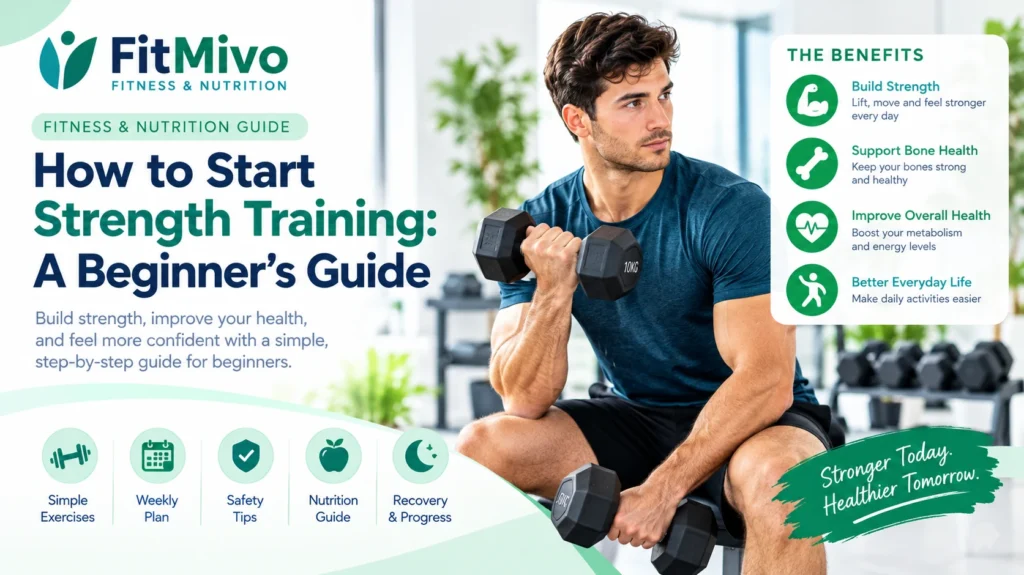
Starting a strength training routine can feel overwhelming when you are unfamiliar with weights, gym equipment, or workout plans. You may wonder which exercises to perform, how often to train, or whether you need a gym membership to get results.
The good news is that strength training for beginners can be simple. You can start with bodyweight exercises at home, use resistance bands, or train with weights at a gym. The most important steps are learning proper technique, choosing manageable exercises, and building a routine you can maintain.
Key Takeaways
- Strength training helps improve muscular strength and supports everyday movement.
- Beginners can start with bodyweight exercises, resistance bands, machines, or free weights.
- Training all major muscle groups at least twice a week is a useful general goal for adults.
- Start with manageable resistance and prioritize good technique over lifting heavier weights.
- Recovery, adequate nutrition, and consistency all contribute to progress.
What Is Strength Training?
Strength training is a type of physical activity that makes your muscles work against resistance. This resistance can come from your own body weight, dumbbells, barbells, resistance bands, weight machines, or other suitable equipment.
When you challenge your muscles regularly and allow enough time for recovery, your body can adapt to the demands of training. Over time, you may become stronger and find everyday activities easier to perform.
Strength training is not only for bodybuilders or experienced athletes. It can be adapted to different fitness levels, goals, and training environments.
What Are the Benefits of Strength Training?
Regular strength training can support several aspects of physical health and fitness.
- Greater muscular strength: Training can help you lift, carry, push, and pull objects more effectively.
- Everyday function: Stronger muscles can support activities such as climbing stairs, carrying groceries, and getting up from a chair.
- Bone health: Appropriate resistance and weight-bearing exercises can support bone health.
- Body composition: Strength training can help build or maintain muscle as part of an overall fitness program.
- Healthy aging: Maintaining strength can support mobility and independence as you get older.
- Physical performance: Strength can contribute to performance in sports and other physical activities.
Results vary depending on your starting point, training routine, health, nutrition, and recovery. You do not need to train like a professional athlete to benefit from regular resistance exercise.
What Do You Need to Start?
You do not need an expensive home gym or a large collection of equipment. Choose an option that matches your budget, space, comfort, and current ability.
| Training Option | Advantages | Things to Consider |
|---|---|---|
| Bodyweight exercises | Low cost and convenient for home workouts | Some movements may need easier variations. |
| Resistance bands | Portable and available in different resistance levels | Check bands for damage and secure them correctly. |
| Dumbbells | Useful for a wide range of exercises | Choose a weight you can control safely. |
| Weight machines | Can guide movement and allow controlled resistance | Learn the adjustments and setup for each machine. |
| Barbells | Allow progressive loading for many exercises | Technique and appropriate safety equipment are important. |
7 Beginner-Friendly Strength Training Exercises
A balanced beginner routine can include movements that train the legs, hips, chest, back, shoulders, arms, and core. You do not need to perform every exercise in this list during your first workout.
1. Squats
Muscles worked: Mainly the quadriceps and glutes, with other muscles helping stabilize the movement.
Stand with your feet approximately shoulder-width apart. Bend your knees and hips, lower yourself as far as you can comfortably control, and return to standing. Keep your feet stable and use a comfortable range of motion.
Beginner variation: Sit down on a sturdy chair and stand back up. Use the chair for support if needed.
2. Wall Push-Ups
Muscles worked: Chest, shoulders, and triceps.
Stand facing a wall and place your hands against it around chest height. Bend your elbows to bring your chest closer to the wall, then push yourself back to the starting position.
Beginner variation: Wall push-ups are often easier than floor push-ups. As you become stronger, you can progress to an appropriately elevated surface or the floor.
3. Glute Bridges
Muscles worked: Glutes and muscles around the hips.
Lie on your back with your knees bent and feet flat on the floor. Gently tighten your glutes and raise your hips until your body forms a comfortable line from your shoulders toward your knees. Lower slowly and repeat.
Avoid arching your lower back excessively or forcing the movement beyond a comfortable range.
4. Resistance Band Rows
Muscles worked: Back muscles and biceps.
With a suitable resistance band securely positioned, hold the handles and pull your elbows backward toward your sides. Keep your torso controlled, then slowly return to the starting position.
Follow the band’s safety instructions and make sure any anchor is secure before beginning.
5. Step-Ups
Muscles worked: Quadriceps and glutes.
Using a stable, low step, place one foot on the platform and step up with control. Step down carefully and repeat. Use a handrail or other stable support when appropriate.
If balance, knee discomfort, or mobility is a concern, choose a simpler alternative, such as chair sit-to-stands.
6. Dumbbell Shoulder Press
Muscles worked: Shoulders and triceps.
Hold light dumbbells around shoulder height. Press them upward in a controlled manner without forcing your joints, then lower them slowly.
Choose a resistance that allows you to maintain control. If overhead movement is uncomfortable, use a suitable alternative or seek professional guidance.
7. Bird Dogs
Muscles worked: Core and muscles that help stabilize the trunk and hips.
Begin on your hands and knees. Slowly extend one arm and the opposite leg while keeping your torso stable. Return to the starting position and alternate sides.
Move slowly rather than lifting your limbs as high as possible. If balancing both limbs is difficult, begin by moving one arm or one leg at a time.
A Simple Weekly Strength Training Plan
For many beginners, two full-body strength sessions per week are a manageable starting point. The following example separates training days so you have time to recover between sessions.
| Day | Activity | Focus |
|---|---|---|
| Monday | Full-body strength training | Practice basic movements with manageable resistance. |
| Tuesday | Walking or gentle activity | General movement and recovery. |
| Wednesday | Rest or gentle activity | Recover according to how you feel. |
| Thursday | Full-body strength training | Repeat the main movements with good technique. |
| Friday | Walking or another aerobic activity | Support overall fitness. |
| Saturday | Optional enjoyable activity | Choose an activity suited to your ability. |
| Sunday | Rest | Prepare for the next week. |
How Many Sets and Repetitions Should Beginners Do?
There is no single set-and-repetition scheme that is ideal for every beginner. A practical approach is to start with a small number of sets and a repetition range that allows you to perform each movement with good technique.
The table below offers a general example for healthy adults who can perform these movements comfortably. Adjust the plan to your ability, and do not treat the numbers as a requirement.
| Exercise Type | Example Starting Point | Main Priority |
|---|---|---|
| Squats or chair sit-to-stands | 1–2 sets of 8–12 repetitions | Controlled movement and stable footing. |
| Wall push-ups | 1–2 sets of 8–12 repetitions | A comfortable range of motion. |
| Band rows | 1–2 sets of 8–12 repetitions | A controlled pull and return. |
| Glute bridges | 1–2 sets of 8–12 repetitions | Comfortable hip movement without excessive back arching. |
| Bird dogs | 1–2 sets of 6–10 repetitions per side | Balance and trunk control. |
Rest between sets for long enough to regain control of your breathing and prepare for the next set. If you cannot maintain good form, reduce the repetitions, choose an easier variation, or use less resistance.
How Do You Choose the Right Weight?
The right starting weight is one that lets you complete your planned repetitions with control and proper technique. The final repetitions may feel challenging, but you should not need to swing the weight, hold your breath excessively, or change your body position to finish.
- Start lighter than you think you need while learning a new exercise.
- Practice the movement before increasing resistance.
- Stop a set when your technique begins to break down.
- Increase resistance gradually when your current workload becomes manageable.
- Ask a qualified trainer for help if you are unsure how to perform an exercise.
You do not need to test your maximum lifting capacity as a beginner. Building a strong foundation is more useful than attempting heavy lifts before you are ready.
How Can You Progress Over Time?
Progressive overload means gradually increasing the challenge placed on your muscles as your body adapts. This does not always require heavier weights.
You might progress by adding a few repetitions, performing an additional set, using a slightly stronger resistance band, or choosing a more challenging variation. Change one aspect at a time so you can judge how your body responds.
There is no need to increase the workload at every workout. If you feel unusually fatigued, experience persistent soreness, or struggle to maintain good technique, keep the workload steady or reduce it while you recover.
Does Nutrition Matter for Strength Training?
Yes. A balanced eating pattern helps support training, recovery, and general health. Your needs depend on your body size, activity level, goals, age, and health status.
- Protein: Protein-rich foods help provide the building blocks your body uses to repair and maintain muscle tissue.
- Carbohydrates: Foods such as whole grains, fruit, and other carbohydrate sources can help provide energy for physical activity.
- Dietary fats: Unsaturated fats from foods such as nuts, seeds, olive oil, and fish can be part of a balanced eating pattern.
- Fluids: Drink regularly and adjust fluid intake to your activity, environment, and individual needs.
- Overall food quality: A varied diet can help you obtain the nutrients needed to support health and exercise.
Supplements are not essential for everyone. If you have a medical condition or specific dietary requirements, a qualified healthcare professional or registered dietitian can help you choose an appropriate approach.
How Much Sleep and Recovery Do You Need?
Recovery is an important part of a sustainable strength training routine. Muscles and other tissues need time to adapt to the demands of exercise, and sleep supports general health and physical performance.
Try to maintain a regular sleep schedule, avoid training the same muscles hard on consecutive days when you are starting out, and adjust your next workout if you have not recovered adequately.
Muscle soreness can happen after unfamiliar exercise, but severe pain, swelling, or pain that interferes with normal movement should not be ignored.
Common Beginner Strength Training Mistakes
1. Lifting Too Heavy Too Soon
Choosing excessive resistance can make it harder to control the movement. Start with manageable loads and build gradually as your technique improves.
2. Skipping the Warm-Up
Begin with several minutes of easy movement and perform lighter practice repetitions of the exercises you plan to do. The warm-up should prepare you for the session rather than exhaust you.
3. Training Only One Muscle Group
Focusing exclusively on arms, chest, or another favorite area can leave important movement patterns undertrained. A balanced routine includes exercises for the major muscle groups.
4. Expecting Immediate Results
Strength develops over time. Focus on learning the exercises, showing up consistently, and gradually improving your performance rather than expecting dramatic changes after a few sessions.
5. Ignoring Pain
Muscle effort is normal during exercise, but sharp or worsening pain is not something to push through. Stop the movement, reassess your technique, and seek professional guidance when needed.
Can You Strength Train at Home Without Equipment?
Yes. Bodyweight exercises can be an effective starting point. Depending on your ability, a simple home routine might include chair sit-to-stands, wall push-ups, glute bridges, supported step-ups, and bird dogs.
Choose variations that let you move comfortably and maintain control. As your strength improves, you can increase repetitions, progress to more challenging versions, or add resistance bands or weights.
Make sure your exercise area is clear and stable. Use sturdy furniture only when it is appropriate for the movement, and avoid improvised equipment that could slip, tip, or break.
When Should You Seek Professional Advice?
If you have a chronic health condition, significant joint or mobility problems, a recent injury, or specific concerns about exercising safely, consult a healthcare professional before starting or substantially changing your routine.
A qualified fitness professional can also help you learn exercise technique, select appropriate resistance, and adapt a program to your abilities.
Stop exercising and seek urgent medical help if you develop chest pain or pressure, fainting, severe shortness of breath, or other serious symptoms. Do not try to push through these warning signs.
Related FitMivo Guides
Explore these FitMivo articles to learn more about fitness, nutrition, and body measurements:
- What Is BMI? A Complete Guide to Body Mass Index
- What Is BMR? A Complete Guide to Basal Metabolic Rate
- What Is TDEE? A Complete Guide to Total Daily Energy Expenditure
- Target Heart Rate: Understanding Exercise Intensity
Frequently Asked Questions
How many days a week should a beginner strength train?
Two full-body sessions per week can be a manageable starting point for many beginners. Your ideal schedule depends on your ability, goals, recovery, and health. Leave enough time between challenging sessions for the same muscles to recover.
Can beginners build muscle with bodyweight exercises?
Yes. Bodyweight exercises can help beginners develop strength, particularly when the movements are challenging enough and become progressively more demanding. Resistance bands and weights are additional options as your ability improves.
How long should a beginner strength workout last?
There is no fixed duration that everyone needs. A session may take around 20–40 minutes depending on the exercises, number of sets, rest periods, and your experience. Focus on safe, effective practice rather than reaching a particular time.
Should I do cardio or strength training first?
It depends on your main goal and the demands of your workout. If strength is your priority, doing resistance training before demanding cardio may help you focus on technique and lifting performance. You can also perform cardio and strength training in separate sessions or on different days.
Can I strength train every day?
You can be physically active every day, but beginners generally do not need to train all major muscle groups hard every day. Include recovery and vary the intensity and type of activity according to your needs.
Do I need supplements to build muscle?
No. Supplements are not a requirement for building strength. Consistent training, adequate food, sufficient protein from suitable sources, and recovery are important foundations. Individual needs vary.
When will I notice results from strength training?
The timeline varies. Beginners may notice improvements in coordination and exercise performance before visible changes in muscle size. Progress depends on consistency, training quality, recovery, nutrition, and individual factors.
Is strength training suitable for older adults?
Strength training can benefit older adults, but exercises should be adapted to their health, mobility, and experience. Anyone with medical concerns or significant balance limitations should seek appropriate professional guidance before starting.
Final Thoughts
Starting strength training does not require complicated workouts, heavy weights, or a perfect routine. Begin with a few basic movements, learn to perform them with control, and train consistently at a level that suits your ability.
As your body adapts, gradually increase the challenge while making time for recovery. Small, sustainable steps can help you build strength and support an active lifestyle over time.
FitMivo — Understand your body. Train smarter.
Sources
- Centers for Disease Control and Prevention — Adult Physical Activity Guidelines
- World Health Organization — Physical Activity
- MedlinePlus — Exercise and Physical Fitness
Medical Disclaimer: This article is for educational purposes only and is not a substitute for professional medical advice, diagnosis, or treatment. Exercise recommendations may not be appropriate for everyone. Consult a qualified healthcare professional for personalized guidance, particularly if you have a medical condition, an injury, or concerning symptoms during physical activity.