
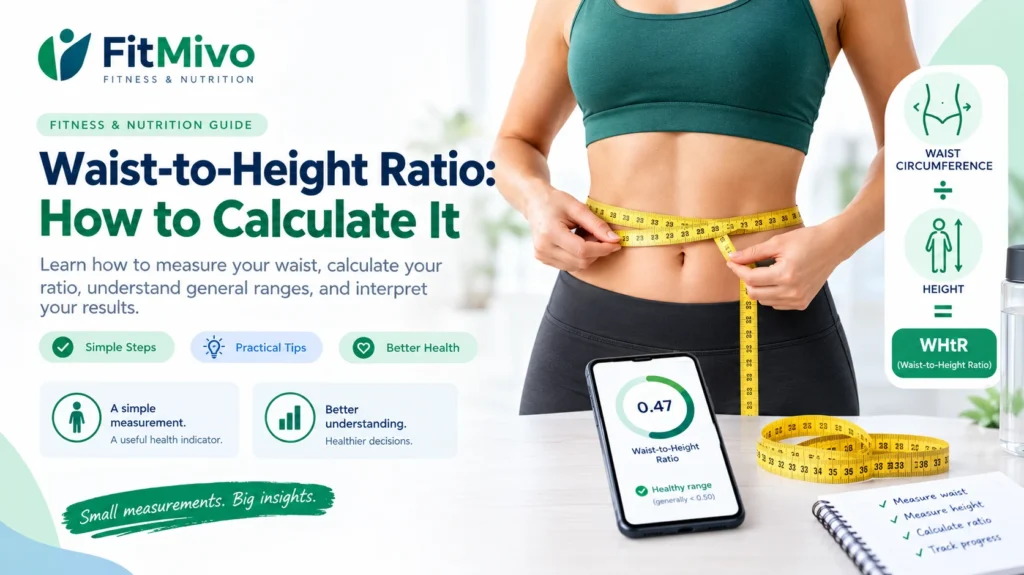
Your waist measurement can provide useful information about how fat is distributed around your body. One simple measurement that helps put waist size into context is the waist-to-height ratio (WHtR).
Unlike BMI, which compares weight with height, waist-to-height ratio compares your waist circumference with your height. It is easy to calculate at home and can be used alongside other health measurements to better understand your body composition.
In this FitMivo guide, you will learn how to calculate your waist-to-height ratio, measure your waist correctly, understand general adult reference ranges, and recognize the limitations of this measurement.
What Is Waist-to-Height Ratio?
Waist-to-height ratio is a measurement that compares the circumference of your waist with your total height. It helps describe abdominal fat distribution, sometimes called central adiposity.
Health professionals may consider this measurement alongside BMI and other information when assessing the risk of conditions associated with excess abdominal fat, including type 2 diabetes, high blood pressure, and cardiovascular disease.
However, waist-to-height ratio does not directly measure body fat percentage. It also cannot tell you everything about your health, fitness, or individual risk.
How to Calculate Waist-to-Height Ratio
The formula is simple:
Waist-to-Height Ratio Formula
WHtR = Waist Circumference ÷ Height
Measure your waist and height in the same unit, such as centimeters or inches. Divide the waist measurement by the height measurement. The result is a ratio, usually written as a decimal.
Example Calculation
Suppose your waist circumference is 80 cm and your height is 170 cm.
- Waist circumference: 80 cm
- Height: 170 cm
- Calculation: 80 ÷ 170 = 0.47
Your waist-to-height ratio is approximately 0.47.
You can use inches instead. For example, a waist of 32 inches and a height of 68 inches gives a ratio of 32 ÷ 68 = approximately 0.47.
How to Measure Your Waist Correctly
Accurate measurements matter. Follow these steps to make your waist measurement more consistent.
Step 1: Stand Naturally
Stand upright with your feet close together and your abdomen relaxed. Avoid pulling your stomach inward or holding your breath.
Step 2: Find the Correct Position
Locate the bottom of your ribs and the top of your hip bones. Place a flexible measuring tape around your waist midway between these points. This position is usually around the area just above your belly button, although individual body shapes vary.
Step 3: Keep the Tape Level
Ensure the tape runs horizontally around your body. It should fit snugly without pressing into your skin.
Step 4: Read the Measurement
Breathe out naturally and record the measurement. If the reading seems uncertain, repeat it and check that the tape is in the same position.
Step 5: Measure Your Height
Stand barefoot against a flat wall, look straight ahead, and measure from the floor to the top of your head. Use a reliable height measurement if you already have one.
Waist-to-Height Ratio Chart for Adults
The following general categories are used in UK NICE guidance for adults with a BMI below 35 kg/m². They are intended to help assess central adiposity, not to diagnose a condition.
| Waist-to-Height Ratio | General category | General interpretation |
|---|---|---|
| Below 0.40 | Below the listed reference range | Interpret in personal and clinical context |
| 0.40–0.49 | Healthy central adiposity range | No increased risk indicated by this measure in the guideline category |
| 0.50–0.59 | Increased central adiposity | Associated with increased health risks |
| 0.60 or higher | High central adiposity | Associated with further increased health risks |
Important: These categories are general guidance, not a personalized medical assessment. The NICE classification is intended for adults with a BMI below 35 kg/m². Children, pregnant people, and people with certain medical conditions may need different assessment methods.
What Does “Keep Your Waist Below Half Your Height” Mean?
A simple way to remember the general adult target is to aim for a waist circumference that is less than half your height.
For example, if you are 170 cm tall, half your height is 85 cm. A waist measurement below 85 cm gives a waist-to-height ratio below 0.50.
This is a practical guideline, not a guarantee of good health. A ratio below 0.50 does not rule out health problems, and a higher ratio does not mean that a person definitely has a disease.
Waist-to-Height Ratio vs. BMI
Waist-to-height ratio and body mass index measure different things. Using them together can sometimes provide more context than relying on either one alone.
| Feature | Waist-to-Height Ratio | BMI |
|---|---|---|
| Measurements | Waist and height | Weight and height |
| What it helps assess | Abdominal fat distribution relative to height | Weight relative to height |
| Direct body fat measurement? | No | No |
| Main limitation | Does not provide a complete health assessment | Does not distinguish fat from muscle |
Learn more in our complete guide to Body Mass Index (BMI) and our article about waist-to-hip ratio.
What Can Affect Your Result?
- Measurement technique: Tape position and tension can change the reading.
- Body shape: People naturally have different body proportions.
- Age and life stage: Body composition can change over time.
- Temporary changes: Bloating can affect waist circumference.
- Health background: Medical history, ethnicity, and other risk factors may influence how measurements should be interpreted.
For tracking purposes, use the same measuring method each time. Avoid making major health decisions based on one measurement alone.
How to Support Your Health
If your waist-to-height ratio is higher than the general target, focus on sustainable habits rather than quick fixes or extreme diets.
- Eat a varied, balanced diet with vegetables, fruit, whole grains, protein foods, and healthy fats.
- Build a regular physical activity routine that suits your abilities and preferences.
- Include strength-building activities when appropriate.
- Prioritize sleep and recovery.
- Discuss concerns about your measurements or health risks with a qualified healthcare professional.
You cannot choose exactly where your body loses fat. Focus on overall health, fitness, and habits that you can maintain over time.
Frequently Asked Questions
How do I calculate waist-to-height ratio?
Divide your waist circumference by your height, using the same unit for both measurements. For example, 80 cm divided by 170 cm gives approximately 0.47.
Is 0.5 a good waist-to-height ratio?
A ratio of 0.50 is the general boundary at which NICE guidance identifies increased central adiposity for adults in the relevant BMI range. It is not a diagnosis, and individual health should be assessed in context.
Can I calculate the ratio using inches?
Yes. Use inches for both waist and height, or centimeters for both. Do not divide a waist measurement in inches by a height measurement in centimeters.
Is waist-to-height ratio better than BMI?
They provide different information. Waist-to-height ratio gives context about waist size relative to height, while BMI compares weight with height. A healthcare professional may consider both alongside other health indicators.
How often should I measure my waist?
There is no single schedule that suits everyone. If you choose to track your measurements, do so occasionally under consistent conditions rather than reacting to small day-to-day changes.
Final Thoughts
Waist-to-height ratio is a simple measurement that can help you understand waist size in relation to height. Measure carefully, use consistent units, and interpret your result alongside other information about your health.
At FitMivo, our goal is to make health and fitness information easier to understand so you can make informed decisions and build sustainable habits.
Sources
- NHS: Calculate Your Waist-to-Height Ratio
- NICE: Identifying and Assessing Overweight, Obesity and Central Adiposity
- NHS: Overweight and Obesity in Adults
Disclaimer: This article is for educational purposes only and is not a substitute for professional medical advice, diagnosis, or treatment.