
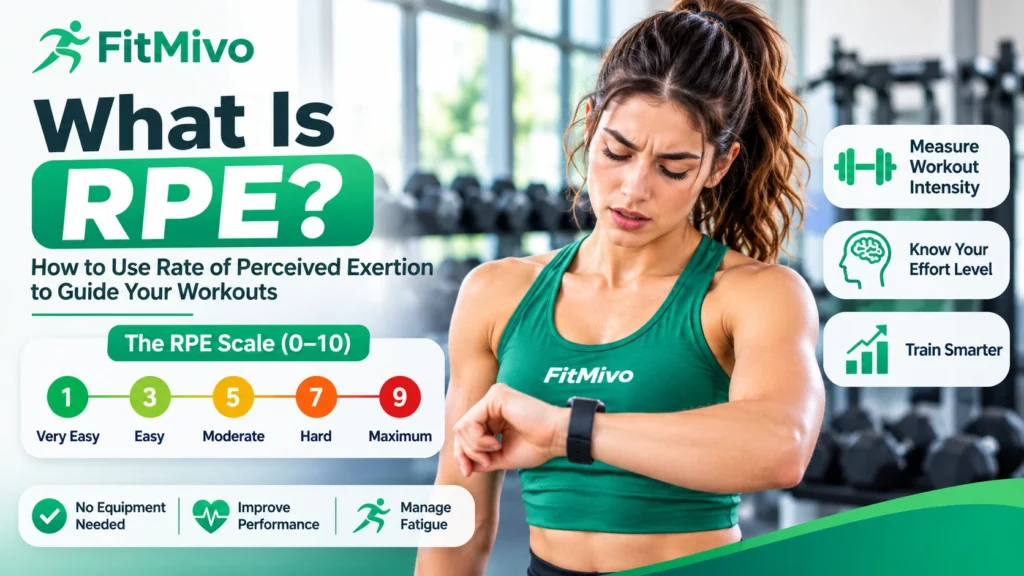
Understanding how hard you are working during exercise is just as important as knowing how many repetitions you complete or how much weight you lift.
Two people can perform the same workout with the same weights but experience very different levels of effort. Sleep, recovery, fitness level, and daily energy can all influence how challenging an exercise feels.
This is where Rate of Perceived Exertion (RPE) becomes useful.
RPE is a simple way to measure how difficult an exercise or workout feels based on your own perception of effort. It can help you adjust training intensity, monitor fatigue, and make more informed decisions about your workouts.
RPE helps you understand how hard your body is working during exercise. Instead of relying only on weights, speed, or heart rate, it uses your personal experience of effort to guide training intensity.
What Is RPE (Rate of Perceived Exertion)?
Rate of Perceived Exertion, commonly called RPE, is a subjective scale used to measure how physically challenging an activity feels.
It considers sensations such as:
- Muscle fatigue.
- Breathing difficulty.
- Overall physical effort.
- How difficult it feels to continue exercising.
For example, walking at a moderate pace may feel easy for someone who exercises regularly but challenging for someone who is new to physical activity.
RPE takes these individual differences into account. Unlike measurements that depend on external devices, RPE requires no special equipment. You simply evaluate how hard the activity feels.
Understanding the RPE Scale
There are different versions of the RPE scale. Two commonly discussed approaches are the traditional Borg scale, which ranges from 6 to 20, and a simplified 0–10 scale.
For everyday fitness and resistance training, the 0–10 scale is particularly easy to understand.
The 0–10 RPE Scale
| RPE Score | Effort Level | Description |
|---|---|---|
| 0 | Rest | No physical effort |
| 1 | Very easy | Almost no effort |
| 2 | Easy | Light activity |
| 3 | Light | Comfortable movement |
| 4 | Moderate | Some effort required |
| 5 | Somewhat hard | Noticeable physical effort |
| 6 | Hard | Challenging but manageable |
| 7 | Very hard | Significant effort |
| 8 | Very challenging | Difficult to maintain |
| 9 | Extremely hard | Close to maximum effort |
| 10 | Maximum | All-out effort |
The numbers represent how difficult an activity feels to you, not a fixed measurement of speed, weight, or calories burned.
What Is the Difference Between RPE 6, 8, and 10?
- RPE 6: You are working hard, but you still have energy to continue.
- RPE 8: The exercise feels very challenging, and you are approaching your limit.
- RPE 10: You are giving your maximum effort and cannot realistically continue at the same intensity.
The important point is that RPE describes perceived effort. It should not be treated as a universal performance measurement.
RPE in Strength Training: Understanding Reps in Reserve (RIR)
In resistance training, RPE is often connected to another useful concept called Reps in Reserve (RIR).
RIR refers to the estimated number of additional repetitions you could complete before reaching muscular failure.
For example, imagine performing 10 repetitions of a dumbbell exercise. If you believe you could perform two more repetitions with proper technique, you have approximately 2 RIR.
A commonly used resistance-training RPE scale connects effort with remaining repetitions:
| Strength Training RPE | Reps in Reserve (RIR) | Meaning |
|---|---|---|
| 10 | 0 | No additional repetitions possible |
| 9 | 1 | One repetition remaining |
| 8 | 2 | Two repetitions remaining |
| 7 | 3 | Three repetitions remaining |
| 6 | 4 | Four repetitions remaining |
| 5 or below | 5+ | Considerably more repetitions available |
Important: This table uses the resistance-training RPE system, which is different from the general 0–10 perceived-effort scale described earlier.
This approach allows you to adjust your training without always lifting to muscular failure.
How to Use RPE During Your Workouts
You do not need complicated calculations to start using RPE. The goal is to become more aware of how your body responds to exercise.
1. Evaluate Your Effort During Each Set
After completing a set, ask yourself:
- How difficult did the exercise feel?
- Could I have completed more repetitions?
- Was my technique still controlled?
- Did I feel close to my physical limit?
2. Adjust Your Training Weight
RPE can help you choose an appropriate weight for the day. If a weight that normally feels manageable suddenly feels extremely difficult, you may need to reduce the load.
This flexibility is useful because your daily performance can change with recovery, sleep, stress, and other factors.
3. Monitor Your Cardio Intensity
RPE is also useful for cardiovascular activities such as walking, running, swimming, and cycling.
- Easy walking may feel like RPE 2–3.
- Brisk walking may feel like RPE 4–5.
- Challenging running may feel like RPE 7–8.
These are illustrative examples, not fixed intensity categories. Your fitness level and the activity itself influence the rating.
4. Track Your Workout Effort Over Time
Recording your RPE after each exercise can help you understand how your training changes over several weeks.
- Exercise name.
- Weight used.
- Number of repetitions.
- Number of sets.
- Estimated RPE.
- General recovery and energy levels.
RPE vs. Heart Rate: What Is the Difference?
RPE and heart rate are two different ways to evaluate exercise intensity.
Heart rate provides a numerical measurement of how many times your heart beats per minute. RPE reflects how difficult the activity feels to you.
| Feature | RPE | Heart Rate |
|---|---|---|
| Measurement | Subjective effort | Beats per minute |
| Equipment | Not required | Monitor or pulse measurement |
| Individual differences | Naturally considered | Requires personal interpretation |
| Useful for | Strength and cardio training | Especially cardio monitoring |
| Main limitation | Requires experience and self-awareness | Can be influenced by several factors |
Both measurements can provide useful information. You can combine RPE with your personal training zones to better understand how your body responds to different exercise intensities.
Explore our related guides:
- Target Heart Rate: How to Calculate Your Training Zone
- Resting Heart Rate: What Is Normal and How to Improve It?
Benefits of Using RPE in Your Fitness Routine
1. Helps You Adjust Training Intensity
Your physical performance is not identical every day. RPE allows you to adapt your workout based on how challenging it feels.
2. Encourages Better Body Awareness
Using RPE regularly helps you recognize the difference between comfortable effort, challenging exercise, and near-maximum intensity.
3. Supports Fatigue Management
Repeatedly training at maximum effort can make recovery more challenging. RPE can help you recognize when a workout is becoming unusually demanding.
4. Works Without Expensive Equipment
You do not need a smartwatch, fitness tracker, or heart-rate monitor to estimate perceived exertion.
5. Complements Other Fitness Measurements
RPE can work alongside calorie estimates, heart-rate information, and training records to develop a more complete picture of your activity.
To understand how daily energy requirements relate to physical activity, read our guide: What Is TDEE? A Complete Guide to Total Daily Energy Expenditure.
Common Mistakes When Using RPE
Although RPE is easy to understand, beginners sometimes find it difficult to estimate their effort accurately.
- Confusing discomfort with maximum effort: A challenging exercise does not automatically mean you have reached your physical limit.
- Comparing your RPE with someone else’s: RPE is individual and depends on your fitness level and experience.
- Ignoring exercise technique: Never sacrifice proper form to reach a higher effort score.
- Trying to reach RPE 10 in every workout: Maximum effort is not necessary for every exercise or training session.
- Expecting perfect accuracy immediately: Estimating remaining repetitions can take practice.
How Beginners Can Start Using RPE
If you are new to RPE, start with a simple approach:
- Choose an exercise you already know how to perform safely.
- Begin with a manageable weight or exercise intensity.
- Complete your planned repetitions while maintaining good technique.
- Estimate how difficult the set felt.
- Record your RPE and compare it with future sessions.
You do not need to push yourself to maximum effort to learn the scale. Over time, you will become more familiar with how different effort levels feel.
Frequently Asked Questions About RPE
What does RPE stand for in fitness?
RPE stands for Rate of Perceived Exertion. It is a method of estimating how difficult physical activity feels based on your personal perception of effort.
What is a good RPE for strength training?
A moderate-to-high effort level, such as RPE 7–8 on the resistance-training scale, is commonly used in strength-training programs. This generally corresponds to approximately 2–3 repetitions remaining.
Is RPE 10 always necessary for muscle growth?
No. Training to maximum effort is not necessary for every set. You can build muscle using different levels of effort, provided your overall training program provides an appropriate stimulus and recovery.
What is the difference between RPE and RIR?
RPE describes how difficult an exercise feels, while RIR estimates how many additional repetitions you could complete before muscular failure.
Can beginners use RPE?
Yes. Beginners can use RPE to develop awareness of exercise intensity. Learning proper technique and choosing manageable exercise loads should remain priorities.
Can RPE be used for running and walking?
Yes. RPE can help evaluate how challenging running, walking, cycling, and other aerobic activities feel.
Is RPE better than heart rate?
Neither measurement is universally better. RPE measures perceived effort, while heart rate provides a numerical cardiovascular measurement. Using both can offer complementary information.
Final Thoughts
Rate of Perceived Exertion is a simple but useful way to understand how hard your body is working during exercise.
Whether you are lifting weights, running, cycling, or walking, RPE can help you adjust your intensity, recognize fatigue, and become more aware of your physical effort.
The key is to use it consistently without treating every workout as a maximum-effort challenge.
Combined with appropriate training, recovery, and nutrition, RPE can become a valuable part of a balanced fitness routine.
At FitMivo, our goal is to make fitness information easier to understand so you can make more informed decisions about your health and training.
Sources and Further Reading
- Helms et al. – Application of the Repetitions in Reserve-Based Rating of Perceived Exertion Scale for Resistance Training
- Feasibility and Usefulness of Repetitions-In-Reserve Scales for Selecting Exercise Intensity – A Scoping Review
- CDC – How to Measure Physical Activity Intensity
- ACSM and ESSA – Physical Activity and Exercise Intensity Terminology
This article is for educational purposes only and does not replace professional medical advice. If you have a medical condition, experience unusual symptoms during exercise, or are unsure about an appropriate training intensity, consult a qualified healthcare professional.