
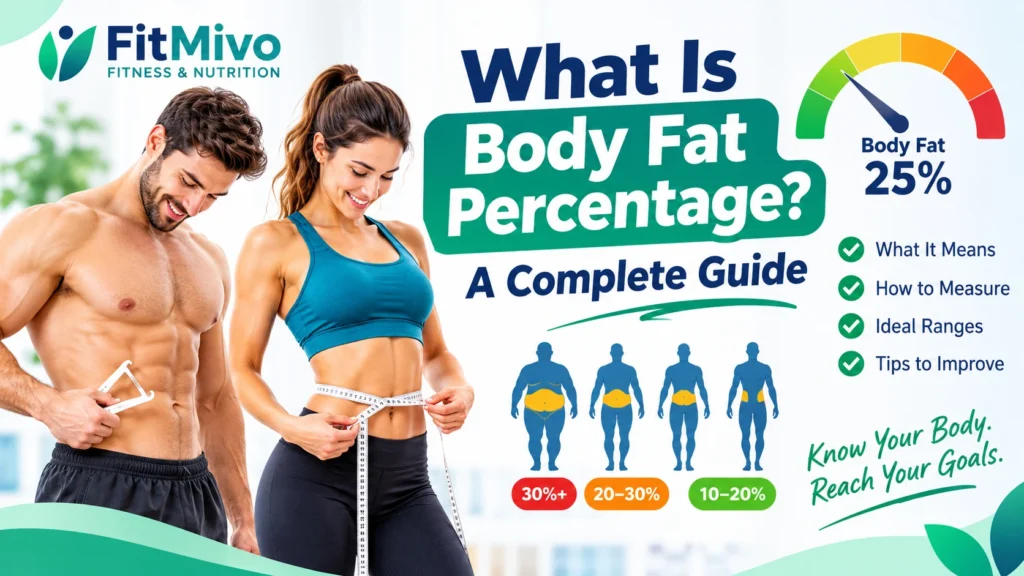
Body fat percentage is one way to understand what your body is made of. While body weight and Body Mass Index (BMI) can provide useful information, they do not show exactly how much of your weight comes from fat and how much comes from lean body mass.
Understanding body fat percentage can help you follow changes in body composition, set realistic fitness goals, and evaluate your progress beyond the number on a scale.
In this guide, you will learn what body fat percentage means, how it is calculated, how it differs from BMI, which measurement methods are available, and how to track changes over time.
Table of Contents
- What Is Body Fat Percentage?
- Understanding Body Composition
- Why Is Body Fat Percentage Important?
- How Is Body Fat Percentage Calculated?
- How to Measure Body Fat
- Body Fat Percentage vs. BMI
- How to Track Changes in Body Fat
- How to Improve Body Composition
- Common Body Fat Measurement Mistakes
- Frequently Asked Questions
What Is Body Fat Percentage?
Body fat percentage is the percentage of your total body weight that consists of fat. It is commonly written as a percentage (%) and is used as one measure of body composition.
For example, if someone weighs 80 kg and has a body fat percentage of 25%, the estimated breakdown is:
- Total body weight: 80 kg
- Fat mass: 20 kg
- Fat-free mass: 60 kg
Fat-free mass includes muscles, bones, organs, water, and other non-fat tissues. It is not the same as muscle mass alone.
Body fat percentage is an estimate rather than a perfect measurement. Different measurement methods and devices can produce different results.
Understanding Body Composition
Body composition describes the different components that make up your body. For many practical fitness purposes, it is useful to think of body weight as two broad categories:
| Component | What It Includes |
|---|---|
| Fat Mass | Essential fat and stored body fat. |
| Fat-Free Mass | Muscles, bones, organs, body water, and other non-fat tissues. |
Body fat itself has important functions. It helps store energy, protects organs, supports temperature regulation, and contributes to normal hormone-related processes.
The goal is not to eliminate body fat. A healthy body needs an appropriate amount of fat to function properly.
Why Is Body Fat Percentage Important?
Body fat percentage can provide information that body weight alone cannot show. Two people may have the same weight and height but different amounts of fat mass and fat-free mass.
1. It provides more information than body weight
Your weight can remain relatively stable while your body composition changes. For example, someone who gains muscle while losing fat may see only a small change on the scale.
2. It helps monitor fitness progress
When combined with strength, fitness, and other health measures, body composition estimates can help you understand whether your training and nutrition routine is producing the changes you want.
3. It supports a broader health assessment
Body fat is one part of overall health. Its amount and distribution may be relevant when assessing health risks, but body fat percentage should not be used alone to diagnose a medical condition.
4. It can help guide realistic goals
Instead of focusing only on losing kilograms, you can pay attention to maintaining strength, supporting muscle mass, improving fitness, and developing sustainable habits.
How Is Body Fat Percentage Calculated?
The basic calculation uses fat mass divided by total body weight.
Body Fat Percentage = (Fat Mass ÷ Total Body Weight) × 100
Example calculation
Imagine a person has the following measurements:
- Total body weight: 80 kg
- Estimated fat mass: 20 kg
The calculation is:
(20 ÷ 80) × 100 = 25%
The estimated body fat percentage is 25%.
In practice, fat mass is usually estimated using a body composition measurement method rather than measured directly at home.
How to Measure Body Fat
There are several ways to estimate body fat percentage. Each method has advantages and limitations, and results from different methods should not automatically be treated as interchangeable.
1. Bioelectrical Impedance Analysis (BIA)
BIA devices send a very small electrical current through the body and use the body’s electrical properties, along with prediction equations, to estimate body composition.
These devices are commonly found in smart scales and body composition monitors.
Advantages:
- Convenient and relatively quick.
- Available in many home devices.
- Useful for following trends when measurements are taken consistently.
Limitations:
- Hydration levels can affect the estimates.
- Different devices may produce different results.
- Individual accuracy can vary depending on the device and its prediction equations.
2. Skinfold Measurements
Skinfold calipers measure the thickness of skinfolds at specific body locations. These measurements are then used in equations to estimate body fat percentage.
Advantages:
- Relatively inexpensive equipment.
- Portable and practical.
- Can be useful when performed by a trained professional.
Limitations:
- Technique and measurement location matter.
- Results can vary between people taking the measurements.
- Some individuals may be difficult to assess accurately using this method.
3. Dual-Energy X-Ray Absorptiometry (DXA)
DXA uses low-dose X-rays to estimate bone mineral content, fat mass, and lean soft tissue. It can also provide information about how body composition is distributed across different regions.
Advantages:
- Provides detailed body composition estimates.
- Can assess regional as well as whole-body composition.
- Used in clinical and research settings.
Limitations:
- Requires specialized equipment.
- Costs more than many home measurement methods.
- Results can vary with equipment, software, and testing procedures.
4. Air Displacement Plethysmography
This method, sometimes associated with the BOD POD system, estimates body volume by measuring air displacement. Body density is then used to estimate body composition.
Advantages:
- Non-invasive measurement.
- Provides an estimate of body composition in a controlled setting.
Limitations:
- Requires specialized equipment.
- Clothing, testing conditions, and hydration can influence results.
- May not be available in all locations.
Comparison of Body Fat Measurement Methods
| Method | Main Advantage | Important Limitation |
|---|---|---|
| BIA | Convenient and widely available | Hydration and device differences affect estimates |
| Skinfolds | Affordable and portable | Depends on measurement technique |
| DXA | Detailed body composition estimates | Requires specialized equipment |
| Air Displacement | Non-invasive assessment | Requires a specialized facility |
Body Fat Percentage vs. BMI: What Is the Difference?
Body fat percentage and Body Mass Index (BMI) are two different measurements. Both can provide useful information, but they do not measure the same thing.
BMI is calculated using weight and height. It is a screening measure and does not directly measure body fat or distinguish fat mass from muscle and other lean tissues.
Body fat percentage estimates the proportion of total body weight that consists of fat.
| Feature | BMI | Body Fat Percentage |
|---|---|---|
| What it measures | Weight relative to height | Estimated proportion of body weight that is fat |
| Uses body weight | Yes | Yes |
| Uses height | Yes | Depends on the measurement method |
| Distinguishes fat from lean mass | No | Estimates the difference |
| Common use | Health screening | Body composition assessment |
For a better understanding of these measurements, read our complete guide to BMI.
How to Track Changes in Body Fat
Tracking body composition can be useful, but the process should be consistent. A single reading may not represent a meaningful change.
Use the same measurement method
Try to use the same device or assessment method each time. Different devices and techniques may produce different estimates.
Keep testing conditions consistent
For home BIA measurements, try to measure at a similar time of day and under similar conditions. Recent food or fluid intake, exercise, and hydration changes can affect readings.
Look at long-term trends
Do not make major decisions based on one measurement. Compare results over several weeks and consider other indicators such as strength, fitness, waist measurements, and how you feel.
Combine measurements with other progress indicators
Body composition is only one part of fitness progress. You can also track:
- Body weight trends.
- Waist circumference.
- Strength and exercise performance.
- Energy levels and recovery.
- Consistency with nutrition and activity habits.
How to Improve Body Composition
If your goal is to improve body composition, focus on sustainable habits rather than trying to achieve a particular number as quickly as possible.
1. Include Strength Training
Resistance training helps develop and maintain muscle strength. A consistent program can include exercises for the major muscle groups, adjusted to your experience and ability.
If you are new to resistance exercise, read our guide to strength training for beginners.
2. Eat Enough Protein
Protein provides amino acids that support muscle repair and growth. Your individual protein needs depend on factors such as body size, activity level, age, and goals.
Use our guide to learn more about how much protein you need each day.
3. Understand Your Daily Energy Needs
Your Total Daily Energy Expenditure (TDEE) is an estimate of how much energy your body uses throughout the day. Understanding it can help you make informed nutrition decisions.
Learn more in our complete guide to TDEE.
4. Stay Physically Active
Regular movement supports overall fitness. Walking, cycling, swimming, and other activities can help you build a more active lifestyle.
5. Prioritize Recovery and Sleep
Sleep and recovery support training performance, daily energy, and general well-being. Avoid treating exercise and nutrition as the only parts of a fitness routine.
6. Be Patient and Consistent
Changes in body composition take time. Extreme diets and excessive exercise are not necessary for sustainable progress. Focus on habits you can maintain.
Common Body Fat Measurement Mistakes
Some common mistakes can make body fat tracking confusing or misleading.
| Mistake | Why It Matters | Better Approach |
|---|---|---|
| Comparing different devices | Devices may use different methods and equations. | Use the same device when tracking trends. |
| Measuring under different conditions | Hydration and recent activity can affect results. | Keep measurement conditions consistent. |
| Focusing on one reading | One result may not show a real long-term change. | Review trends over time. |
| Ignoring other health indicators | Body fat percentage does not describe overall health. | Consider fitness, strength, waist measurements, and medical guidance. |
| Chasing the lowest possible number | Very low body fat is not automatically healthier. | Focus on sustainable habits and individual needs. |
Frequently Asked Questions
What does body fat percentage mean?
Body fat percentage is the proportion of your total body weight that comes from fat mass. It is expressed as a percentage and is used to describe one aspect of body composition.
How do I calculate my body fat percentage?
The basic formula is fat mass divided by total body weight, multiplied by 100. Since fat mass is not usually measured directly at home, a body composition device or assessment method is generally used to estimate it.
Is body fat percentage better than BMI?
Neither measurement is universally better. BMI is a simple screening tool based on weight and height, while body fat percentage estimates the proportion of body weight that is fat. They provide different information and can be considered together.
Can smart scales accurately measure body fat?
Smart scales generally use bioelectrical impedance to estimate body composition. Their results can be affected by hydration, device design, and prediction equations. They may be more useful for tracking trends under consistent conditions than for treating one reading as an exact measurement.
Why does my body fat percentage change from day to day?
Changes in hydration, food and fluid intake, recent exercise, and measurement conditions can affect some body composition estimates. A short-term change does not necessarily mean that your actual fat mass has changed.
Can I lose fat and gain muscle at the same time?
It is possible for some people to reduce fat mass while increasing or maintaining muscle mass, particularly when following an appropriate resistance-training and nutrition routine. Results depend on training experience, nutrition, recovery, and individual factors.
Does a lower body fat percentage always mean better health?
No. Body fat has essential functions, and very low levels may be inappropriate or harmful for some people. Health should be assessed using a broader range of factors rather than one number.
How often should I measure body fat?
There is no single schedule that works for everyone. If you choose to track it, use the same method and consistent conditions, and focus on longer-term trends rather than frequent individual readings.
Key Takeaways
- Body fat percentage describes the proportion of body weight that comes from fat.
- Fat-free mass includes muscle, bones, organs, water, and other non-fat tissues.
- Body fat percentage and BMI measure different things.
- BIA scales, skinfolds, DXA, and air displacement are different ways to estimate body composition.
- Measurement methods have limitations, so results should be interpreted carefully.
- Consistent measurements and long-term trends are more useful than one isolated reading.
- Strength training, balanced nutrition, physical activity, and recovery can support healthier body composition.
Final Thoughts
Body fat percentage can help you understand your body composition beyond the number on a scale. It provides a different perspective from BMI and body weight, especially when you want to follow changes in fat mass and fat-free mass.
However, no single measurement tells the whole story. Use body composition estimates as one tool alongside healthy habits, fitness progress, and appropriate medical advice.